



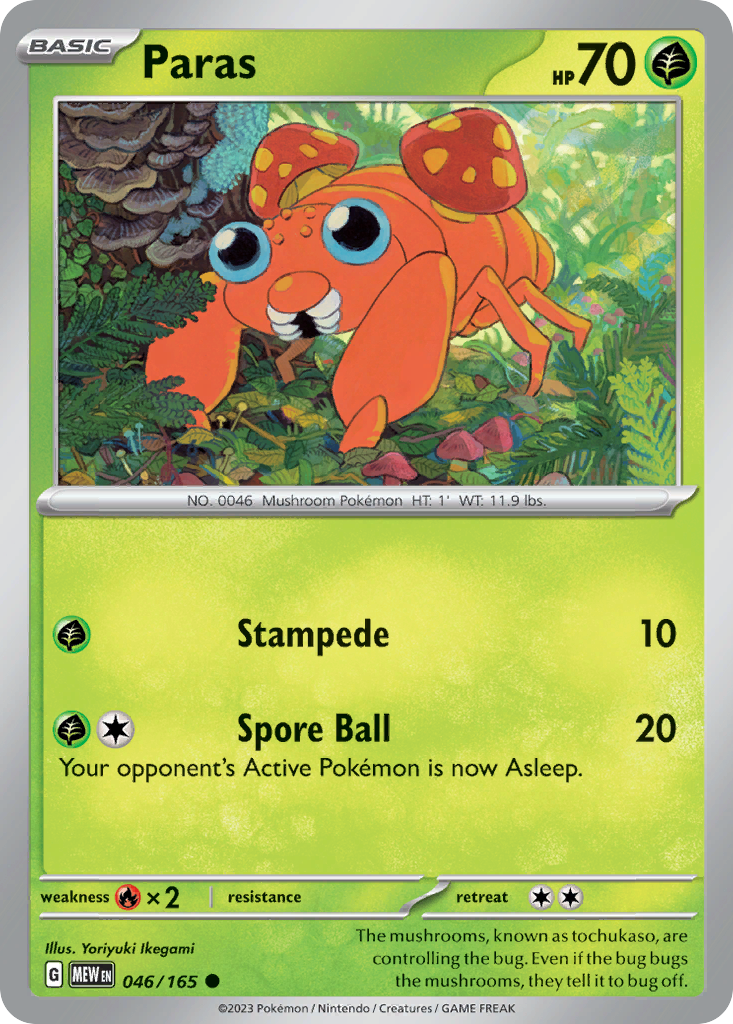
Paras

The mushrooms, known as tochukaso, are controlling the bug. Even if the bug bugs the mushrooms, they tell it to bug off.

| Supertype | Pokémon |
|---|---|
| Subtype | Basic |
| HP | 70 |
| Attack | Stampede |
| Attack cost | Grass |
| Artist | Yoriyuki Ikegami |
| Rarity | Common |
| Pokédex | 46 |
| Evolves to | Parasect |
Vendor Information
- Store Name: DutchGem
- Vendor: DutchGem
-
Address:
gekkestraat
179
2345GT Utrecht
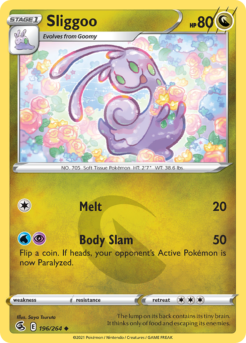
Fusion Strike
The lump on its back contains its tiny brain. It thinks only of food and escaping its enemies.

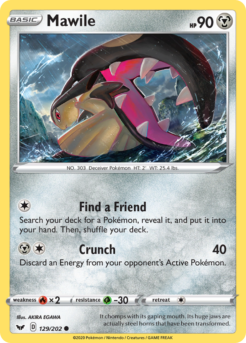
Sword & Shield
It chomps with its gaping mouth. Its huge jaws are actually steel horns that have been transformed.

Sun & Moon
Those who sleep holding Cresselia's feather are assured of joyful dreams. It is said to represent the crescent moon.
Sun & Moon
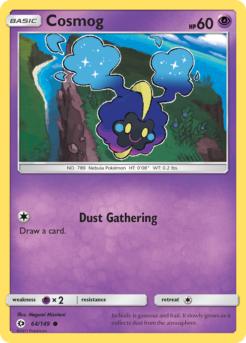
Its body is gaseous and frail. It slowly grows as it collects dust from the atmosphere.
Paldea Evolved
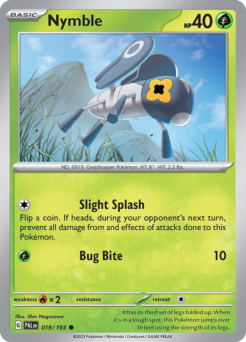
It has its third set of legs folded up. When it's in a tough spot, this Pokémon jumps over 30 feet using the strength of its legs.
Related products
Scarlet & Violet
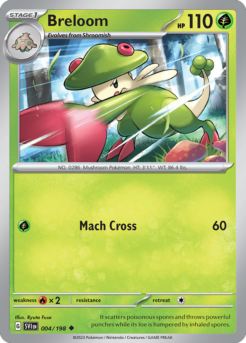
It scatters poisonous spores and throws powerful punches while its foe is hampered by inhaled spores.
Scarlet & Violet
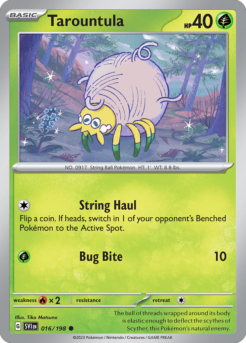
The ball of threads wrapped around its body is elastic enough to deflect the scythes of Scyther, this Pokémon's natural enemy.
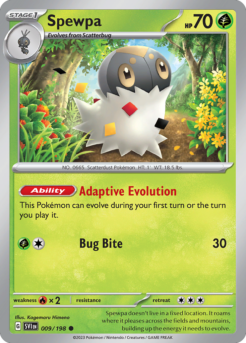
Scarlet & Violet
Spewpa doesn't live in a fixed location. It roams where it pleases across the fields and mountains, building up the energy it needs to evolve.
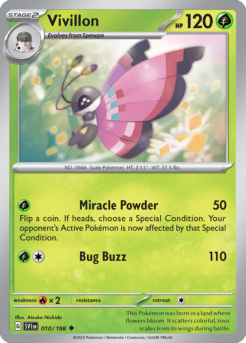
Scarlet & Violet
This Pokémon was born in a land where flowers bloom. It scatters colorful, toxic scales from its wings during battle.
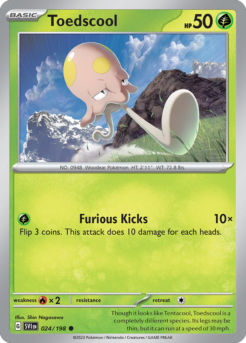
Scarlet & Violet
Though it looks like Tentacool, Toedscool is a completely different species. Its legs may be thin, but it can run at a speed of 30 mph.
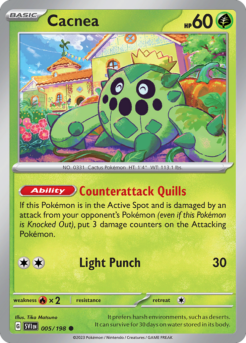
Scarlet & Violet
It prefers harsh environments, such as deserts. It can survive for 30 days on water stored in its body.
Scarlet & Violet
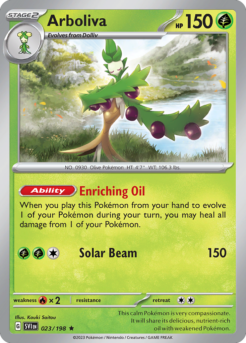
This calm Pokémon is very compassionate. It will share its delicious, nutrient-rich oil with weakened Pokémon.
Scarlet & Violet
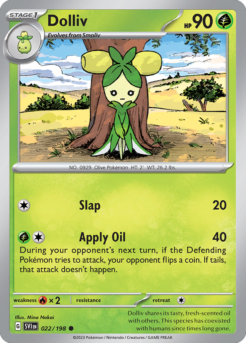
Dolliv shares its tasty, fresh-scented oil with others. This species has coexisted with humans since times long gone.