
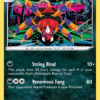
| Supertype | Pokémon |
|---|---|
| Subtype | Basic |
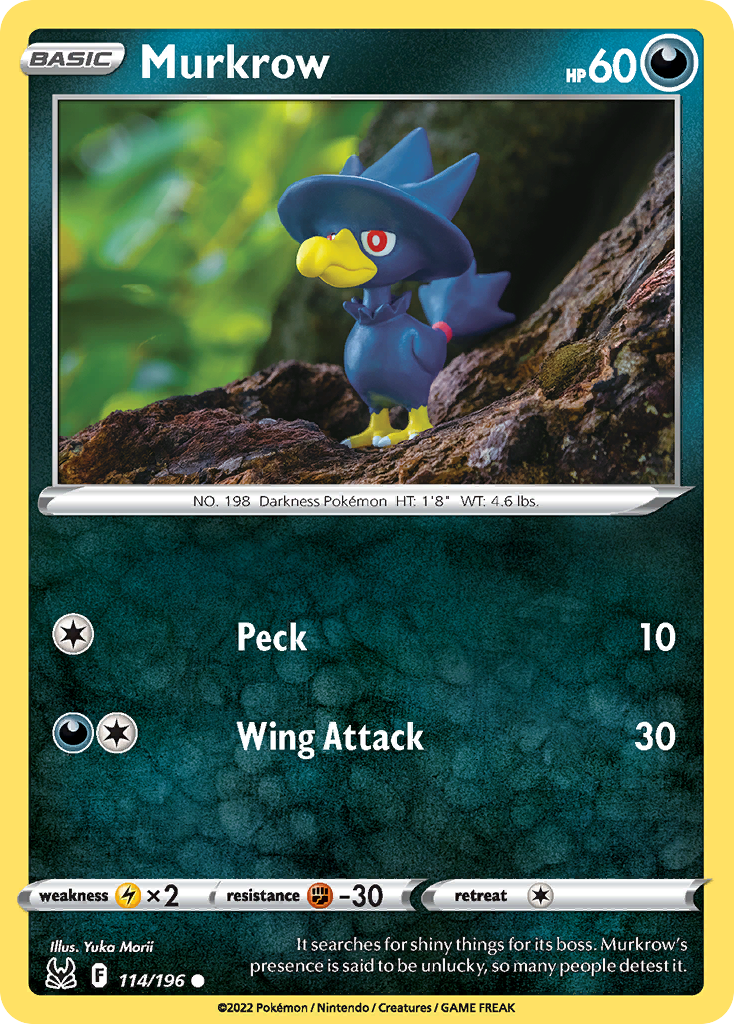
| HP | 60 |
| Types | Darkness |
| Attack | Peck |
| Attack cost | Colorless |
| Artist | Yuka Morii |
| Rarity | Common |
| Pokédex | 198 |
| Evolves to | Honchkrow |
Murkrow
It searches for shiny things for its boss. Murkrow's presence is said to be unlucky, so many people detest it.
Vendor Information
- Store Name: DutchGem
- Vendor: DutchGem
-
Address:
gekkestraat
179
2345GT Utrecht
Primal Clash
The chances of two Spinda having identical spot patterns is less than one in four billion.
Burning Shadows
This attack does 30 damage times the amount of Energy attached to both Active Pokémon.
Paldea Evolved
It can't see, so its first approach to examining things is to bite them. You will be covered in wounds until a Deino warms up to you.
Base
During the day, it keeps its face buried in the ground. At night, it wanders around sowing its seeds.
Paldean Fates
The larger pair protects the little ones during battles. When facing strong opponents, the whole group will join the fight.
מוצרים קשורים
Sword & Shield
It is said to live 1,000 years, and each of its tails is loaded with supernatural powers.
Sword & Shield
Its flowers give off a relaxing fragrance. The stronger its aroma, the healthier the Roselia is.
Sword & Shield
It whirls around in the wind while singing a joyous song. This delightful display has charmed many into raising this Pokémon.
Sword & Shield
There's a hole in its tail that allows it to draw in the air it needs to keep its fire burning. If the hole gets blocked, this Pokémon will fall ill.
Sword & Shield
After captivating opponents with its sweet scent, it lashes them with its thorny whips.
Sword & Shield
It emits psychic energy to observe and study what's around it—and what's around it can include things over six miles away.
Sword & Shield
By drumming, it taps into the power of its special tree stump. The roots of the stump follow its direction in battle.
Sword & Shield
Its venom sacs produce a fluid that this Pokémon then heats up with the flame in its tail. This process creates Salandit's poisonous gas.