

| Supertype | Pokémon |
|---|---|
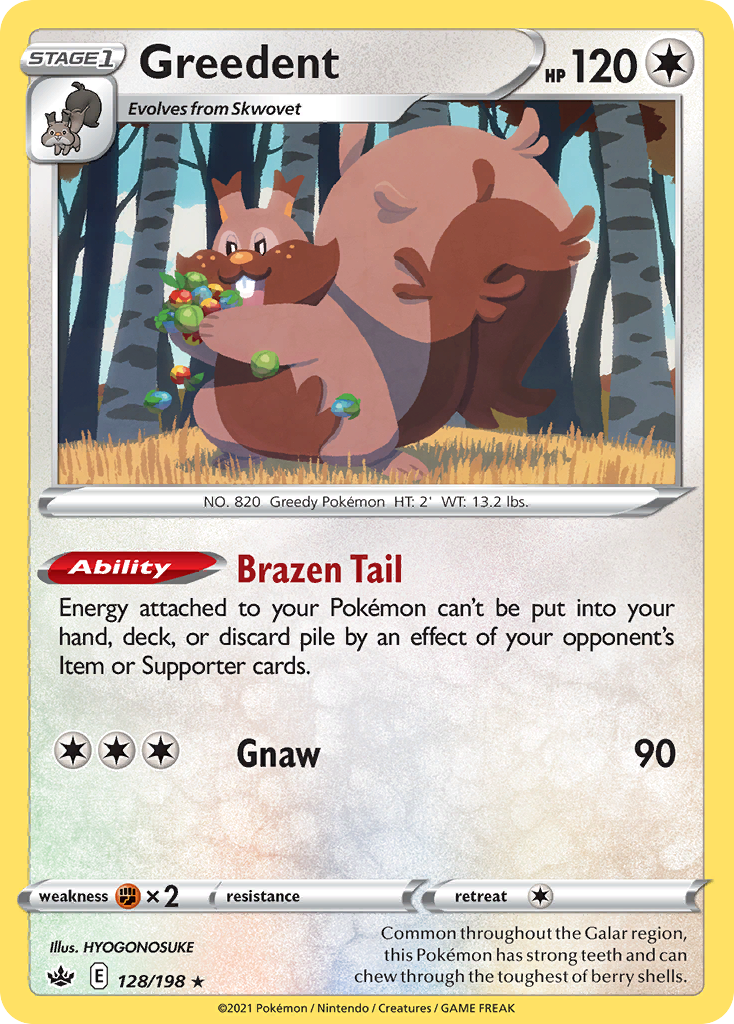
| Subtype | Stage 1 |
| HP | 120 |
| Types | Colorless |
| Attack | Gnaw |
| Attack cost | Colorless |
| Artist | HYOGONOSUKE |
| Rarity | Rare Holo |
| Pokédex | 820 |
| Evolves from | Skwovet |
Greedent
Common throughout the Galar region, this Pokémon has strong teeth and can chew through the toughest of berry shells.
Información del vendedor
- Nombre de la tienda: DutchGem
- Vendedor: DutchGem
-
Dirección:
gekkestraat
179
2345GT Utrecht

Astral Radiance
Though large and languid, Hippopotas is difficult to detect due to its tendency to burrow into and lurk beneath the soil. When agitated or excited, it expels sand from its nostrils.
Fusion Strike
Vullaby grow quickly. Bones that have gotten too small for older Vullaby to wear often get passed down to younger ones in the nest.
Shining Legends
Able to conceal itself in shadows, it never appears before humans, so its very existence was the stuff of myth.
Scarlet & Violet
If this Pokémon evolved from Gimmighoul during this turn, this attack does 90 more damage.
Productos relacionados
Sword & Shield
By drumming, it taps into the power of its special tree stump. The roots of the stump follow its direction in battle.
Sword & Shield
Only female Salazzle exist. They emit a gas laden with pheromones to captivate male Salandit.
Sword & Shield
By drumming, it taps into the power of its special tree stump. The roots of the stump follow its direction in battle.
Sword & Shield
It is said to live 1,000 years, and each of its tails is loaded with supernatural powers.
Sword & Shield
While young, it has six gorgeous tails. When it grows, several new tails are sprouted.
Sword & Shield
The faster a Thwackey can beat out a rhythm with its two sticks, the more respect it wins from its peers.
Sword & Shield
With noises that could be mistaken for the rattles of maracas, it creates an upbeat rhythm, startling bird Pokémon and making them fly off in a hurry.
Sword & Shield
Its venom sacs produce a fluid that this Pokémon then heats up with the flame in its tail. This process creates Salandit's poisonous gas.