
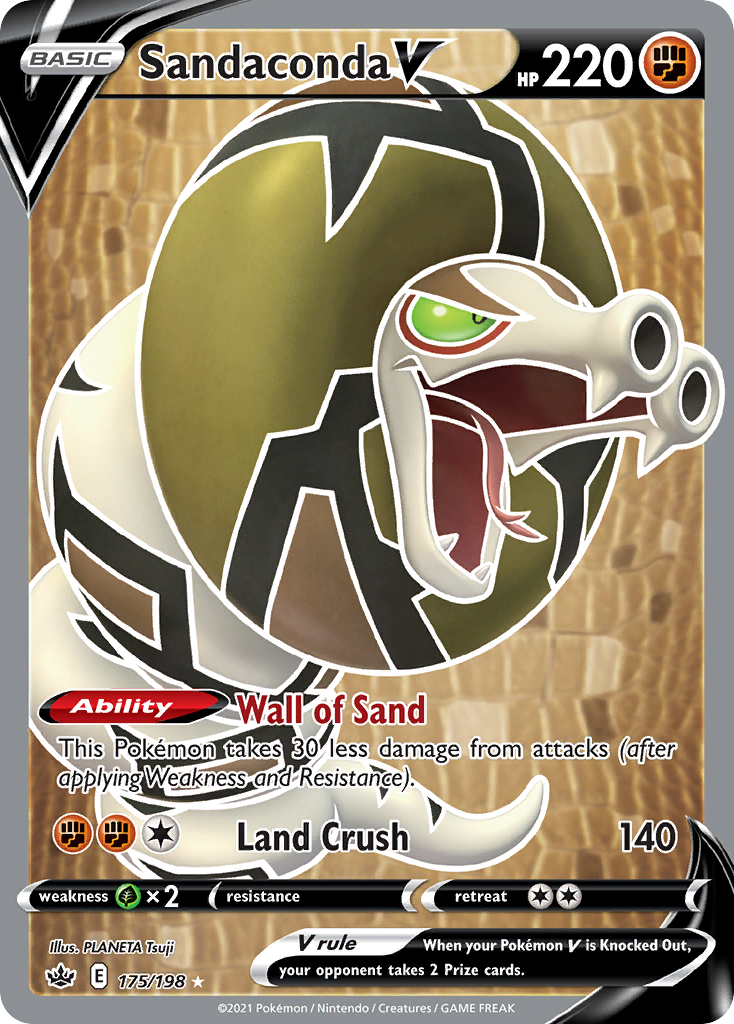
| Supertype | Pokémon |
|---|---|
| Subtype | Basic |
| HP | 220 |
| Types | Fighting |
| Attack | Land Crush |
| Attack cost | Fighting |
| Artist | PLANETA Tsuji |
| Rarity | Rare Ultra |
| Pokédex | 844 |
Vendor Information
- Store Name: DutchGem
- Vendor: DutchGem
-
Address:
gekkestraat
179
2345GT Utrecht
XY
It has a twig stuck in its tail. With friction from its tail fur, it sets the twig on fire and launches into battle.
Chilling Reign
During your opponent’s next turn, they can’t play any Special Energy or Stadium cards from their hand.
Paldea Evolved
People used to mistake Oranguru for a human when they saw it issue command after command to the other Pokémon of the forest.
Sun & Moon
This attack does 30 damage to 1 of your opponent’s Benched Pokémon. (Don’t apply Weakness and Resistance for Benched Pokémon.)
Burning Shadows
Because it turns active on nights of the full moon, it is said to have some link to the lunar phases.
Evolutions
A life-form whose identity is unknown. It is said to Screech or suddenly Self-Destruct.
Produtos Relacionados
Sword & Shield
Its flowers give off a relaxing fragrance. The stronger its aroma, the healthier the Roselia is.
Sword & Shield
Its flowers give off a relaxing fragrance. The stronger its aroma, the healthier the Roselia is.
Sword & Shield
The faster a Thwackey can beat out a rhythm with its two sticks, the more respect it wins from its peers.
Sword & Shield
By drumming, it taps into the power of its special tree stump. The roots of the stump follow its direction in battle.
Sword & Shield
The cotton on the head of this Pokémon can be spun into a glossy, gorgeous yarn—a Galar regional specialty.
Sword & Shield
It shoots cotton from its body to protect itself. If it gets caught up in hurricane-strength winds, it can get sent to the other side of the Earth.
Sword & Shield
It whirls around in the wind while singing a joyous song. This delightful display has charmed many into raising this Pokémon.
Sword & Shield
Its venom sacs produce a fluid that this Pokémon then heats up with the flame in its tail. This process creates Salandit's poisonous gas.