
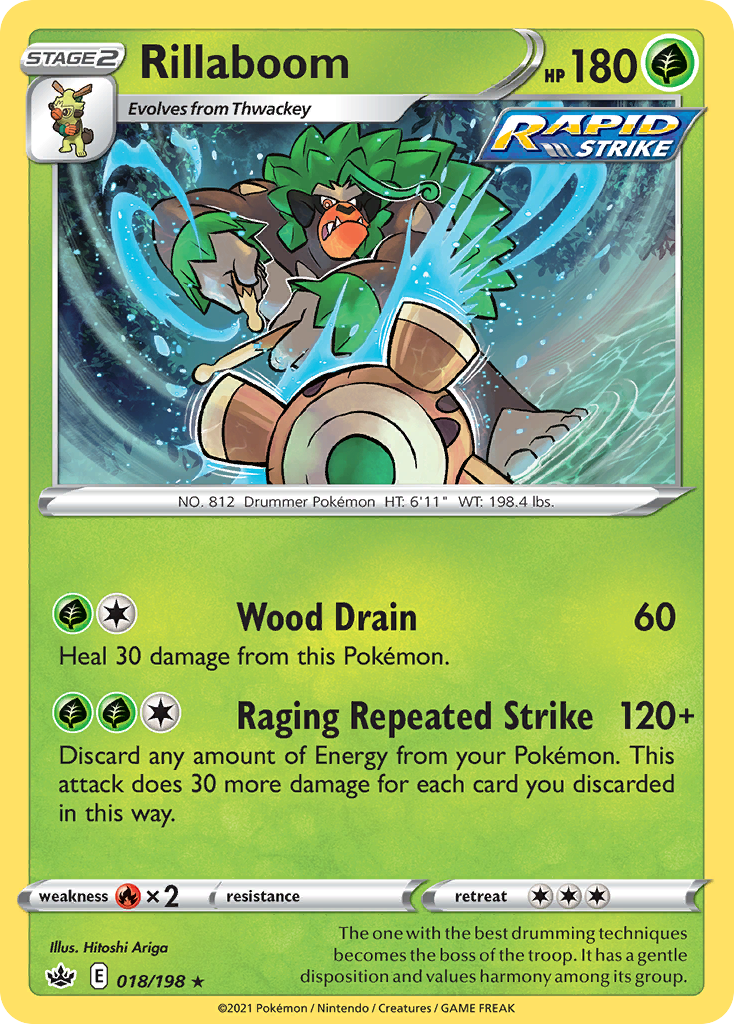
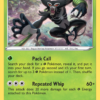

Heal 30 damage from this Pokémon.
Rillaboom
The one with the best drumming techniques becomes the boss of the troop. It has a gentle disposition and values harmony among its group.
| Supertype | Pokémon |
|---|---|
| Subtype | Stage 2 |
| HP | 180 |
| Types | Grass |
| Attack | Wood Drain |
| Attack cost | Grass |
| Artist | Hitoshi Ariga |
| Rarity | Rare Holo |
| Pokédex | 812 |
| Evolves from | Thwackey |
Vendor Information
- Store Name: DutchGem
- Vendor: DutchGem
-
Address:
gekkestraat
179
2345GT Utrecht

Paldean Fates
It's said that no foe can remain invisible to Lucario, since it can detect auras—even those of foes it could not otherwise see.
Silver Tempest
When its mane is standing on end, you can tell it's feeling good. When it isn't feeling well, its fur will lie down flat.
Scarlet & Violet
After captivating opponents with its sweet scent, it lashes them with its thorny whips.
Paradox Rift
It traps enemies with its suction-cupped tentacles, then smashes them with its rock-hard head.
Crimson Invasion
It loves iron ore. Groups of them fight for territory by bashing one another with their steel bodies.
Produtos Relacionados
Sword & Shield
The faster a Thwackey can beat out a rhythm with its two sticks, the more respect it wins from its peers.
Sword & Shield
While young, it has six gorgeous tails. When it grows, several new tails are sprouted.
Sword & Shield
It is said to live 1,000 years, and each of its tails is loaded with supernatural powers.
Sword & Shield
The cotton on the head of this Pokémon can be spun into a glossy, gorgeous yarn—a Galar regional specialty.
Sword & Shield
They lay their eggs deep inside their nests. When attacked by Heatmor, they retaliate using their massive mandibles.
Sword & Shield
The faster a Thwackey can beat out a rhythm with its two sticks, the more respect it wins from its peers.
Sword & Shield
A constant collector of information, this Pokémon is very smart. Very strong is what it isn't.
Sword & Shield
Its venom sacs produce a fluid that this Pokémon then heats up with the flame in its tail. This process creates Salandit's poisonous gas.