
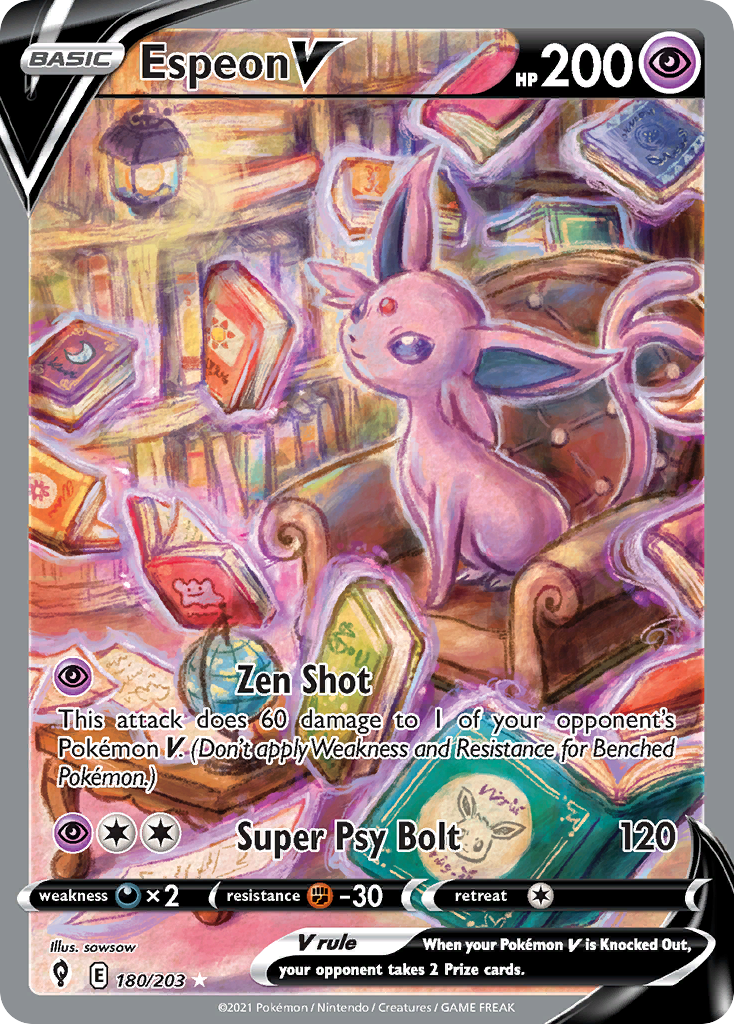


This attack does 60 damage to 1 of your opponent’s Pokémon V. (Don’t apply Weakness and Resistance for Benched Pokémon.)
| Supertype | Pokémon |
|---|---|
| Subtype | Basic |
| HP | 200 |
| Types | Psychic |
| Attack | Zen Shot |
| Attack cost | Psychic |
| Artist | sowsow |
| Rarity | Rare Ultra |
| Pokédex | 196 |
Vendor Information
- Store Name: DutchGem
- Vendor: DutchGem
-
Address:
gekkestraat
179
2345GT Utrecht
Sun & Moon
Volcanoes or dry, craggy places are its home. It emanates a sweet-smelling poisonous gas that attracts bug Pokémon, then attacks them.
Evolutions
Its body is covered with a pure white fur. The colder the weather, the more active it becomes.
Steam Siege
They attach themselves to large-bodied Pokémon and absorb static electricity, which they store in an electric pouch.
Lost Thunder
It's found crawling on beaches and seafloors. The coral that grows on Corsola's head is as good as a five-star banquet to this Pokémon.
Scarlet & Violet
Before doing damage, discard all Pokémon Tools and Special Energy from your opponent’s Active Pokémon.
Produtos Relacionados
Sword & Shield
After captivating opponents with its sweet scent, it lashes them with its thorny whips.
Sword & Shield
Attach up to 3 Fire Energy cards from your discard pile to your Pokémon in any way you like.
Sword & Shield
The cotton on the head of this Pokémon can be spun into a glossy, gorgeous yarn—a Galar regional specialty.
Sword & Shield
By drumming, it taps into the power of its special tree stump. The roots of the stump follow its direction in battle.
Sword & Shield
When it uses its special stick to strike up a beat, the sound waves produced carry revitalizing energy to the plants and flowers in the area.
Sword & Shield
As it grows inside its shell, it uses its psychic abilities to monitor the outside world and prepare for evolution.
Sword & Shield
Often found in gardens, this Pokémon has hairs on its body that it uses to assess its surroundings.
Sword & Shield
Its venom sacs produce a fluid that this Pokémon then heats up with the flame in its tail. This process creates Salandit's poisonous gas.