
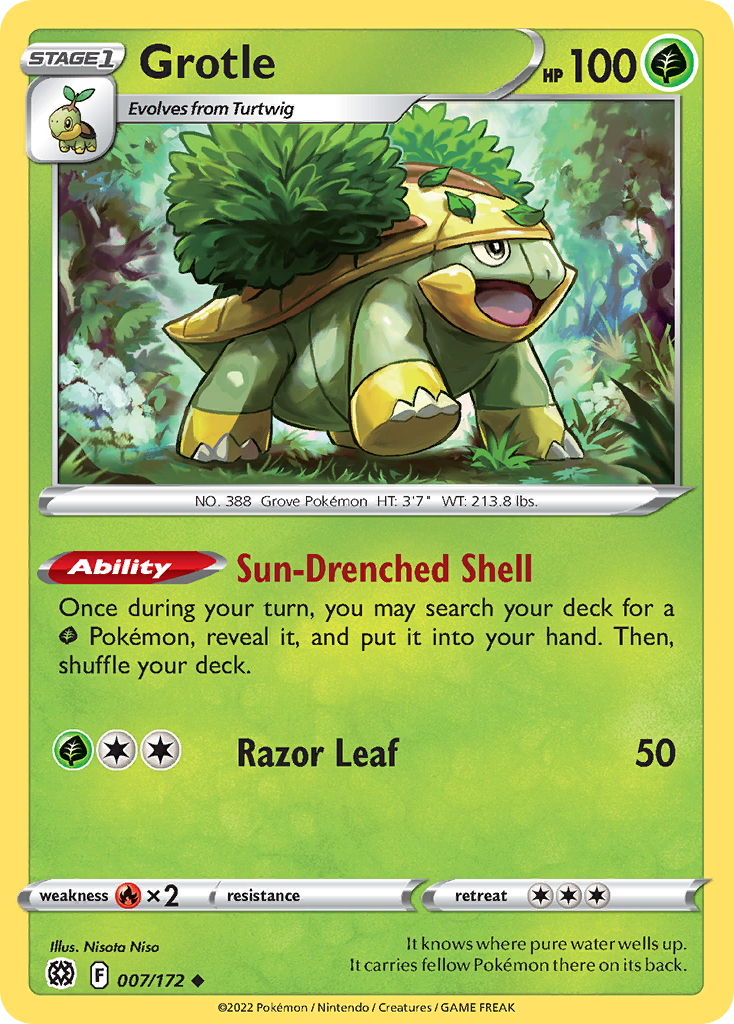
| Supertype | Pokémon |
|---|---|
| Subtype | Stage 1 |
| HP | 100 |
| Types | Grass |
| Attack | Razor Leaf |
| Attack cost | Grass |
| Artist | Nisota Niso |
| Rarity | Uncommon |
| Pokédex | 388 |
| Evolves from | Turtwig |
| Evolves to | Torterra |
Grotle
It knows where pure water wells up. It carries fellow Pokémon there on its back.
Vendor Information
- Store Name: DutchGem
- Vendor: DutchGem
-
Address:
gekkestraat
179
2345GT Utrecht
Flashfire
Found in fields and mountains. Mistaking them for boulders, people often step or trip on them.
Sword & Shield
This Pokémon is very popular as a herding dog in the Galar region. As it runs, it generates electricity from the base of its tail.
Evolving Skies
It has been found that its brain cells are 10 times more active when Psyduck is experiencing a headache.
Silver Tempest
Its goons take care of most of the fighting for it. The only time it dirties its own hands is in delivering a final blow to finish off an opponent.
Produtos Relacionados
Sword & Shield
It scatters cotton all over the place as a prank. If it gets wet, it'll become too heavy to move and have no choice but to answer for its mischief.
Sword & Shield
It whirls around in the wind while singing a joyous song. This delightful display has charmed many into raising this Pokémon.
Sword & Shield
If any of your Grass Pokémon were Knocked Out by damage from an opponent’s attack during their last turn, this attack does 90 more damage.
Sword & Shield
With noises that could be mistaken for the rattles of maracas, it creates an upbeat rhythm, startling bird Pokémon and making them fly off in a hurry.
Sword & Shield
They lay their eggs deep inside their nests. When attacked by Heatmor, they retaliate using their massive mandibles.
Sword & Shield
Its flowers give off a relaxing fragrance. The stronger its aroma, the healthier the Roselia is.
Sword & Shield
A constant collector of information, this Pokémon is very smart. Very strong is what it isn't.
Sword & Shield
Its venom sacs produce a fluid that this Pokémon then heats up with the flame in its tail. This process creates Salandit's poisonous gas.