



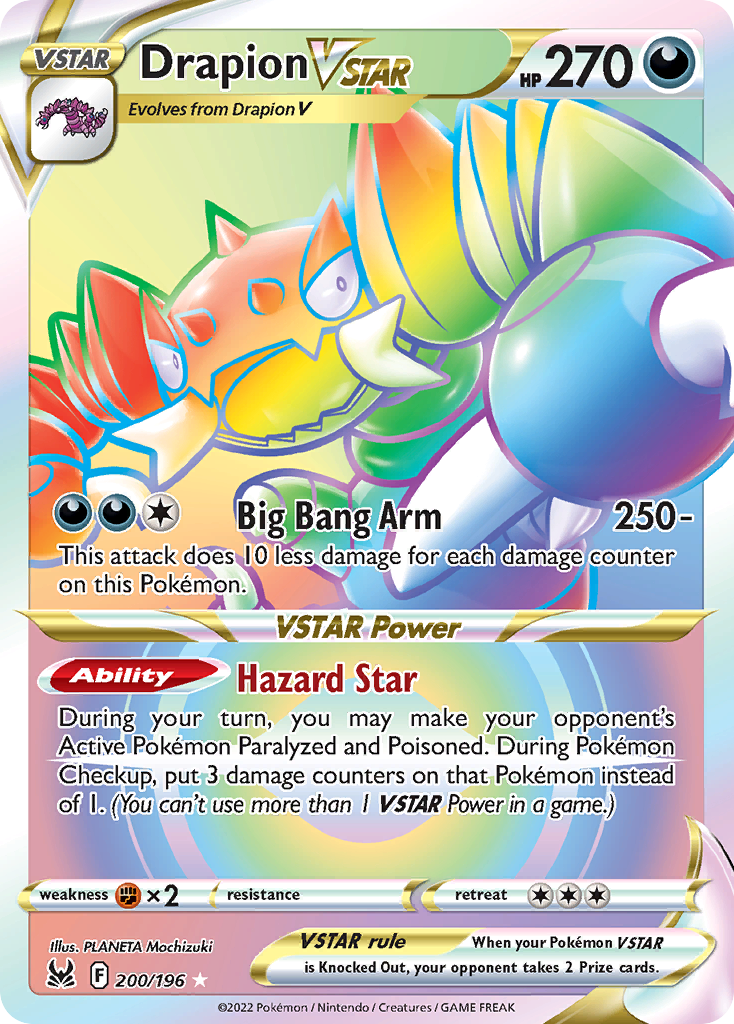
This attack does 10 less damage for each damage counter on this Pokémon.
| Supertype | Pokémon |
|---|---|
| Subtype | VSTAR |
| HP | 270 |
| Types | Darkness |
| Attack | Big Bang Arm |
| Attack cost | Darkness |
| Artist | PLANETA Mochizuki |
| Rarity | Rare Rainbow |
| Pokédex | 452 |
| Evolves from | Drapion V |
Vendor Information
- Store Name: DutchGem
- Vendor: DutchGem
-
Address:
gekkestraat
179
2345GT Utrecht

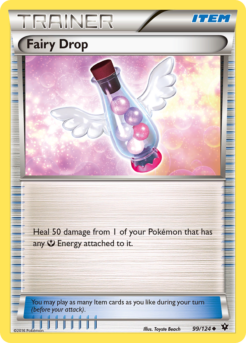
Fates Collide
It stores Berries inside its shell. To avoid attacks, it hides beneath rocks and remains completely still.
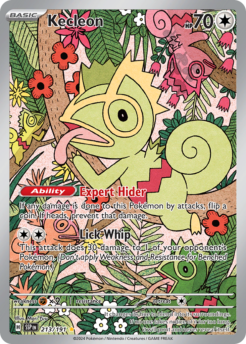
Scarlet & Violet
This attack does 30 damage to 1 of your opponent’s Pokémon. (Don’t apply Weakness and Resistance for Benched Pokémon.)
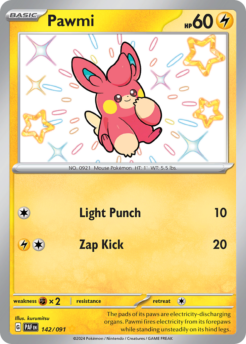
Paldean Fates
The pads of its paws are electricity-discharging organs. Pawmi fires electricity from its forepaws while standing unsteadily on its hind legs.
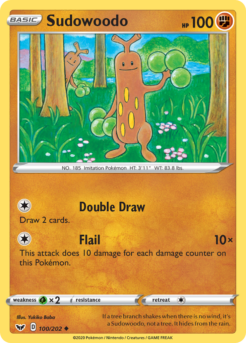
Sword & Shield
If a tree branch shakes when there is no wind, it's a Sudowoodo, not a tree. It hides from the rain.
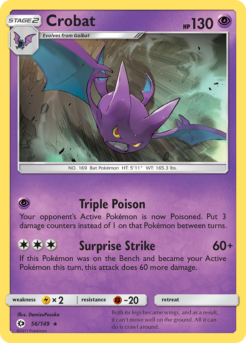
Sun & Moon
Both its legs became wings, and as a result, it can't move well on the ground. All it can do is crawl around.
Related products
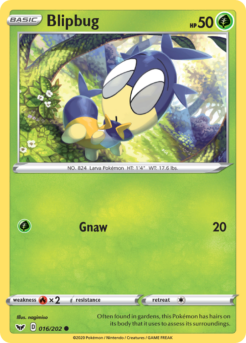
Sword & Shield
Often found in gardens, this Pokémon has hairs on its body that it uses to assess its surroundings.
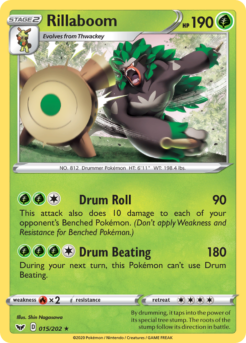
Sword & Shield
By drumming, it taps into the power of its special tree stump. The roots of the stump follow its direction in battle.

Sword & Shield
Search your deck for up to 2 Pokémon, reveal them, and put them into your hand. Then, shuffle your deck.
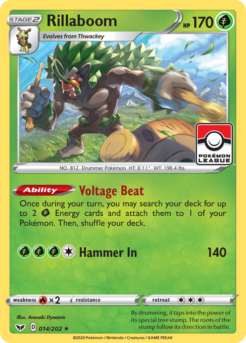
Sword & Shield
By drumming, it taps into the power of its special tree stump. The roots of the stump follow its direction in battle.
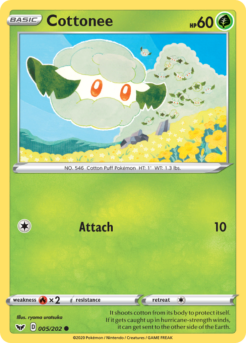
Sword & Shield
It shoots cotton from its body to protect itself. If it gets caught up in hurricane-strength winds, it can get sent to the other side of the Earth.
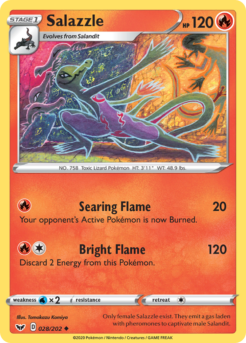
Sword & Shield
Only female Salazzle exist. They emit a gas laden with pheromones to captivate male Salandit.
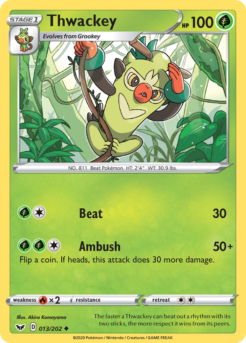
Sword & Shield
The faster a Thwackey can beat out a rhythm with its two sticks, the more respect it wins from its peers.
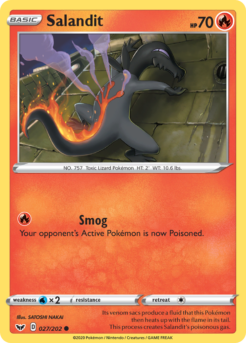
Sword & Shield
Its venom sacs produce a fluid that this Pokémon then heats up with the flame in its tail. This process creates Salandit's poisonous gas.