



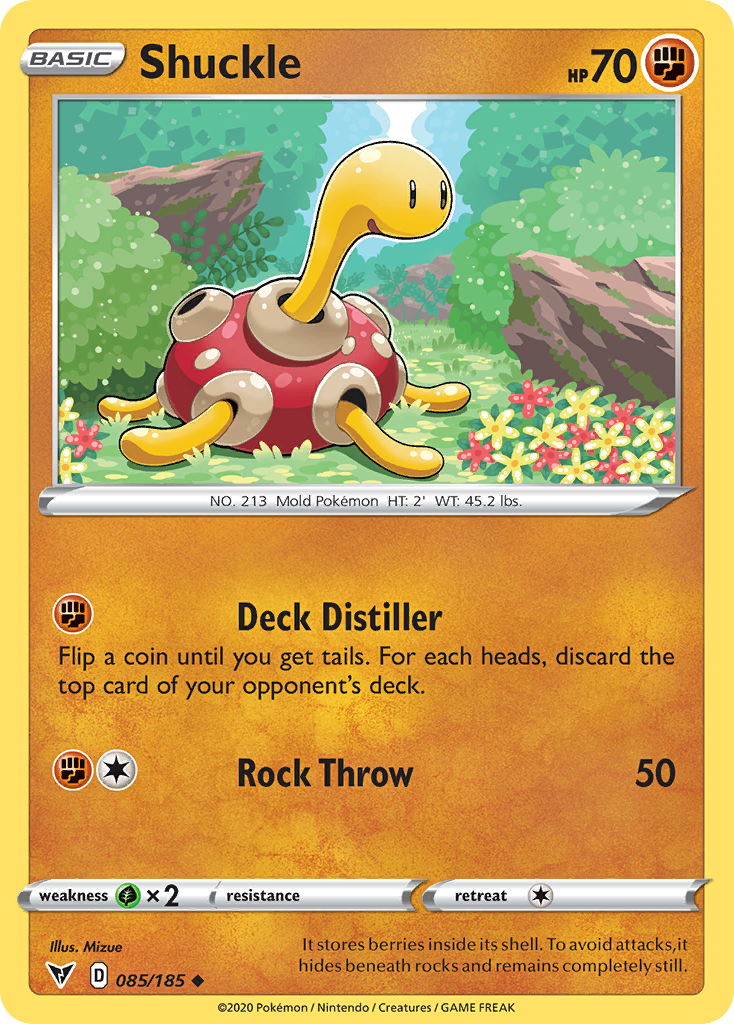
Shuckle


It stores berries inside its shell. To avoid attacks, it hides beneath rocks and remains completely still.

Flip a coin until you get tails. For each heads, discard the top card of your opponent’s deck.
| Supertype | Pokémon |
|---|---|
| Subtype | Basic |
| HP | 70 |
| Types | Fighting |
| Attack | Deck Distiller |
| Attack cost | Fighting |
| Artist | Mizue |
| Rarity | Uncommon |
| Pokédex | 213 |
Vendor Information
- Store Name: DutchGem
- Vendor: DutchGem
-
Address:
gekkestraat
179
2345GT Utrecht

Rebel Clash
After a lost child perished in the forest, their spirit possessed a tree stump, causing the spirit's rebirth as this Pokémon.
Sun & Moon
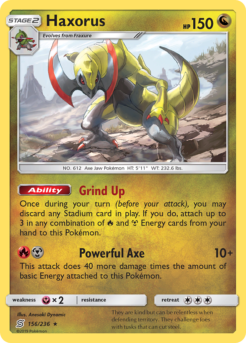
They are kind but can be relentless when defending territory. They challenge foes with tusks that can cut steel.


BREAKpoint
Its swiftness is unparalleled. It can scale a tower of more than 2,000 feet in a minute's time.

Primal Clash
Through yoga training, it gained the psychic power to predict its foe's next move.

Forbidden Light
Its knuckle claws secrete a toxin so vile that even a scratch could prove fatal.
Related products
Sword & Shield
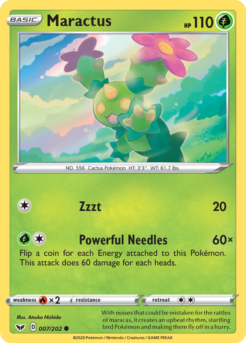
With noises that could be mistaken for the rattles of maracas, it creates an upbeat rhythm, startling bird Pokémon and making them fly off in a hurry.

Sword & Shield
As it grows inside its shell, it uses its psychic abilities to monitor the outside world and prepare for evolution.

Sword & Shield
There's a hole in its tail that allows it to draw in the air it needs to keep its fire burning. If the hole gets blocked, this Pokémon will fall ill.

Sword & Shield
When it uses its special stick to strike up a beat, the sound waves produced carry revitalizing energy to the plants and flowers in the area.
Sword & Shield
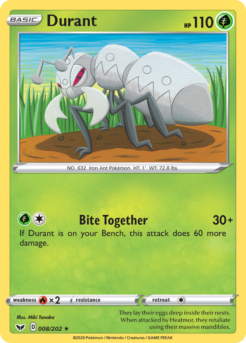
They lay their eggs deep inside their nests. When attacked by Heatmor, they retaliate using their massive mandibles.

Sword & Shield
When it uses its special stick to strike up a beat, the sound waves produced carry revitalizing energy to the plants and flowers in the area.

Sword & Shield
By drumming, it taps into the power of its special tree stump. The roots of the stump follow its direction in battle.
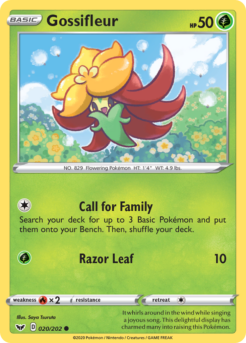
Sword & Shield
It whirls around in the wind while singing a joyous song. This delightful display has charmed many into raising this Pokémon.