
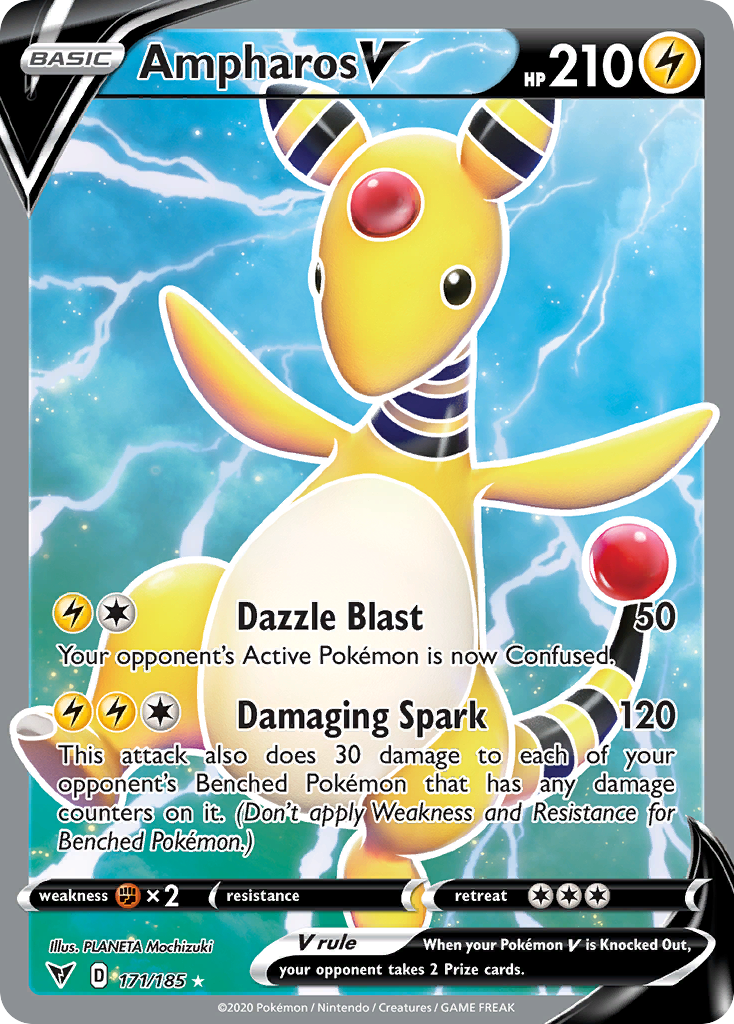


Your opponent’s Active Pokémon is now Confused.
| Supertype | Pokémon |
|---|---|
| Subtype | Basic |
| HP | 210 |
| Types | Lightning |
| Attack | Dazzle Blast |
| Attack cost | Lightning |
| Artist | PLANETA Mochizuki |
| Rarity | Rare Ultra |
| Pokédex | 181 |
Vendor Information
- Store Name: DutchGem
- Vendor: DutchGem
-
Address:
gekkestraat
179
2345GT Utrecht
BREAKthrough
It enshrouds itself with sand to protect itself from germs. It does not enjoy getting wet.
Battle Styles
It bounces around on its tail to keep its heart pumping. It carries a pearl from Clamperl on its head.
Cosmic Eclipse
Its habitat is dark forests and caves. It emits ultrasonic waves from its nose to learn about its surroundings.
Burning Shadows
Opponents who stare at the flashing of the light-emitting spots on its body become dazed and lose their will to fight.
Guardians Rising
Its favorite foods are Wingull and Pikipek. It attacks with a powerful kick and grasps them firmly in its talons.
Podobne produkty
Sword & Shield
When it uses its special stick to strike up a beat, the sound waves produced carry revitalizing energy to the plants and flowers in the area.
Sword & Shield
With noises that could be mistaken for the rattles of maracas, it creates an upbeat rhythm, startling bird Pokémon and making them fly off in a hurry.
Sword & Shield
If any of your Grass Pokémon were Knocked Out by damage from an opponent’s attack during their last turn, this attack does 90 more damage.
Sword & Shield
It shoots cotton from its body to protect itself. If it gets caught up in hurricane-strength winds, it can get sent to the other side of the Earth.
Sword & Shield
Often found in gardens, this Pokémon has hairs on its body that it uses to assess its surroundings.
Sword & Shield
A constant collector of information, this Pokémon is very smart. Very strong is what it isn't.
Sword & Shield
It is said to live 1,000 years, and each of its tails is loaded with supernatural powers.
Sword & Shield
Its venom sacs produce a fluid that this Pokémon then heats up with the flame in its tail. This process creates Salandit's poisonous gas.