
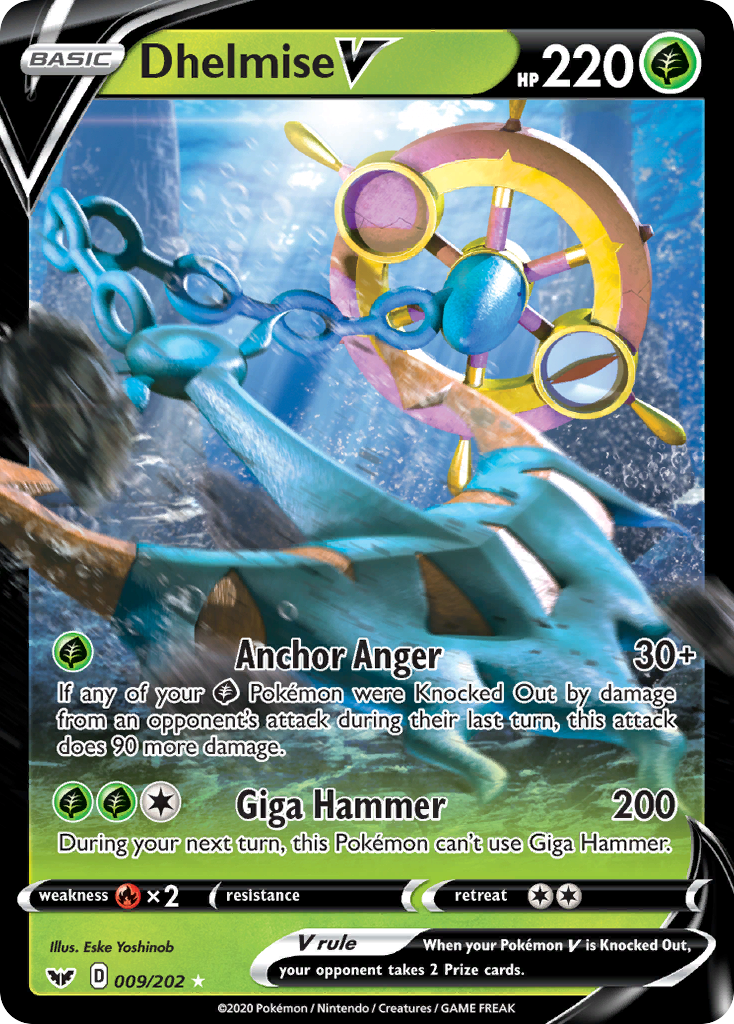
If any of your Grass Pokémon were Knocked Out by damage from an opponent’s attack during their last turn, this attack does 90 more damage.
| Supertype | Pokémon |
|---|---|
| Subtype | Basic |
| HP | 220 |
| Types | Grass |
| Attack | Anchor Anger |
| Attack cost | Grass |
| Artist | Eske Yoshinob |
| Rarity | Rare Holo V |
| Pokédex | 781 |
Vendor Information
- Store Name: DutchGem
- Vendor: DutchGem
-
Address:
gekkestraat
179
2345GT Utrecht
Sword & Shield
It fights using the scalchop on its stomach. In response to an attack, it retaliates immediately by slashing.
Scarlet & Violet
During your opponent’s next turn, this Pokémon takes 60 less damage from attacks (after applying Weakness and Resistance).
Paldean Fates
Frigibax absorbs heat through its dorsal fin and converts the heat into ice energy. The higher the temperature, the more energy Frigibax stores.
Paradox Rift
Attach up to 2 Basic Psychic Energy cards from your discard pile to your Pokémon in any way you like.
Podobne produkty
Sword & Shield
When it uses its special stick to strike up a beat, the sound waves produced carry revitalizing energy to the plants and flowers in the area.
Sword & Shield
When it uses its special stick to strike up a beat, the sound waves produced carry revitalizing energy to the plants and flowers in the area.
Sword & Shield
Attach up to 3 Fire Energy cards from your discard pile to your Pokémon in any way you like.
Sword & Shield
Explosive substances coat the shell on its back. Enemies that dare attack it will be blown away by an immense detonation.
Sword & Shield
With noises that could be mistaken for the rattles of maracas, it creates an upbeat rhythm, startling bird Pokémon and making them fly off in a hurry.
Sword & Shield
Discard the top card of your deck. If that card is a Fire Energy card, this attack does 90 more damage.
Sword & Shield
It emits psychic energy to observe and study what's around it—and what's around it can include things over six miles away.
Sword & Shield
Its venom sacs produce a fluid that this Pokémon then heats up with the flame in its tail. This process creates Salandit's poisonous gas.