
| Supertype | Pokémon |
|---|---|
| Subtype | Stage 1 |
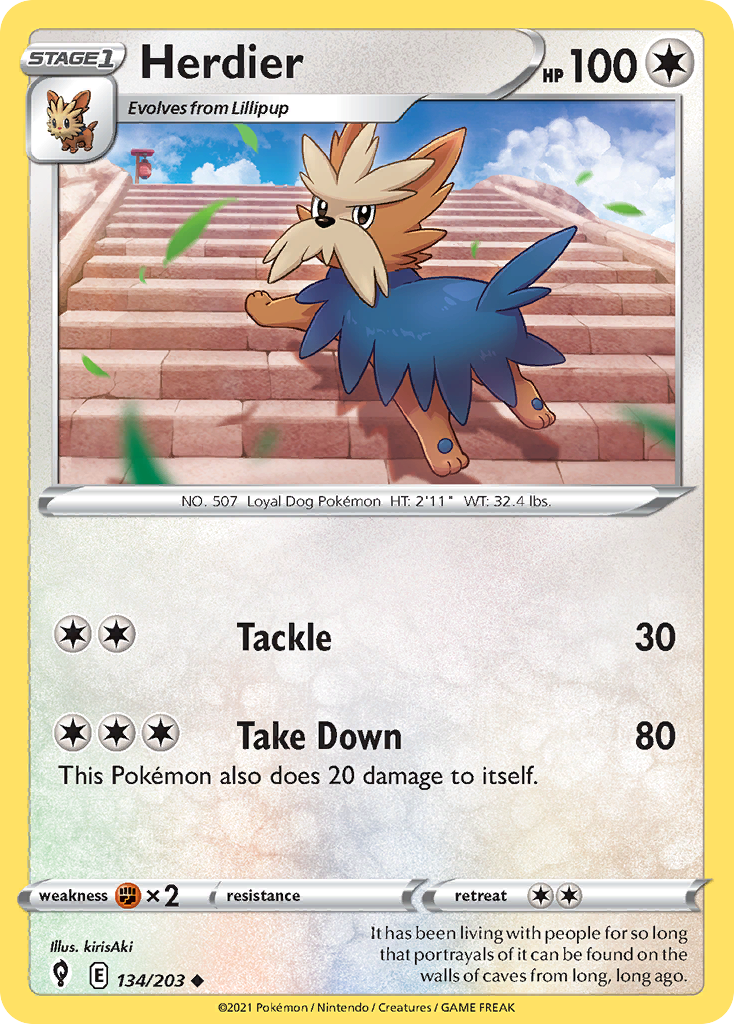
| HP | 100 |
| Types | Colorless |
| Attack | Tackle |
| Attack cost | Colorless |
| Artist | kirisAki |
| Rarity | Uncommon |
| Pokédex | 507 |
| Evolves from | Lillipup |
| Evolves to | Stoutland |
Herdier
It has been living with people for so long that portrayals of it can be found on the walls of caves from long, long ago.
Vendor Information
- Store Name: DutchGem
- Vendor: DutchGem
-
Address:
gekkestraat
179
2345GT Utrecht

Sword & Shield
It flies at high speeds around the skies. When it finds its prey, Metang takes a firm grip with its sharp claws and never lets go.
Guardians Rising
It is said to live in another world. The intense light it radiates from the surface of its body can make the darkest of nights light up like midday.
Scarlet & Violet
Its tail moves with greater dexterity than its hands. Making deft use of this tail, Aipom lives high among the treetops.
Silver Tempest
Lives in the shadows of tall trees where it eats bugs. It is attracted by light at night.
Related products
Sword & Shield
The cotton on the head of this Pokémon can be spun into a glossy, gorgeous yarn—a Galar regional specialty.
Sword & Shield
There's a hole in its tail that allows it to draw in the air it needs to keep its fire burning. If the hole gets blocked, this Pokémon will fall ill.
Sword & Shield
It scatters cotton all over the place as a prank. If it gets wet, it'll become too heavy to move and have no choice but to answer for its mischief.
Sword & Shield
After captivating opponents with its sweet scent, it lashes them with its thorny whips.
Sword & Shield
They lay their eggs deep inside their nests. When attacked by Heatmor, they retaliate using their massive mandibles.
Sword & Shield
The faster a Thwackey can beat out a rhythm with its two sticks, the more respect it wins from its peers.
Sword & Shield
A constant collector of information, this Pokémon is very smart. Very strong is what it isn't.
Sword & Shield
Its venom sacs produce a fluid that this Pokémon then heats up with the flame in its tail. This process creates Salandit's poisonous gas.