
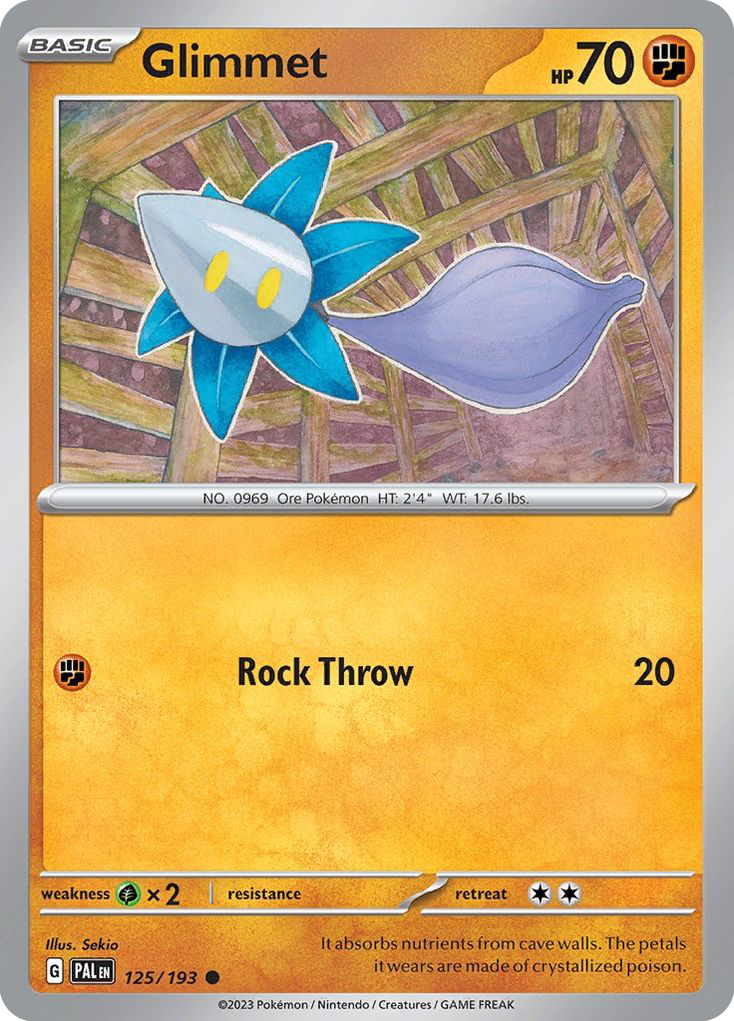
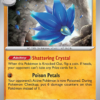
| Supertype | Pokémon |
|---|---|
| Subtype | Basic |
| HP | 70 |
| Types | Fighting |
| Attack | Rock Throw |
| Attack cost | Fighting |
| Artist | Sekio |
| Rarity | Common |
| Pokédex | 969 |
Glimmet
It absorbs nutrients from cave walls. The petals it wears are made of crystallized poison.
Vendor Information
- Store Name: DutchGem
- Vendor: DutchGem
-
Address:
gekkestraat
179
2345GT Utrecht

Obsidian Flames
The soul of someone who died alone possessed some leftover tea. This Pokémon appears in hotels and houses.
Lost Thunder
The spirits burned up in its ominous flame lose their way and wander this world forever.
Chilling Reign
Put damage counters on 1 of your opponent’s Pokémon until its remaining HP is 100.
Base
Its tongue can be extended like a chameleon's. It leaves a stinging sensation when it licks enemies.
Evolutions
Often found in forests and grasslands. It has a sharp, toxic barb of around two inches on top of its head.
Related products
Scarlet & Violet
It protects itself from enemies by emitting oil from the fruit on its head. This oil is bitter and astringent enough to make someone flinch.
Scarlet & Violet
Dolliv shares its tasty, fresh-scented oil with others. This species has coexisted with humans since times long gone.
Scarlet & Violet
Its fluffy fur is similar in composition to plants. This Pokémon frequently washes its face to keep it from drying out.
Scarlet & Violet
Traditional Paldean dishes can be extremely spicy because they include the shed front teeth of Capsakid among their ingredients.
Scarlet & Violet
Traditional Paldean dishes can be extremely spicy because they include the shed front teeth of Capsakid among their ingredients.
Scarlet & Violet
This Pokémon scatters poisonous powder to repel enemies. It will eat different plants depending on where it lives.
Scarlet & Violet
Though it looks like Tentacool, Toedscool is a completely different species. Its legs may be thin, but it can run at a speed of 30 mph.
Scarlet & Violet
It can sense the feelings of others by touching them with its horns. This species has assisted people with their work since 5,000 years ago.