
| Supertype | Pokémon |
|---|---|
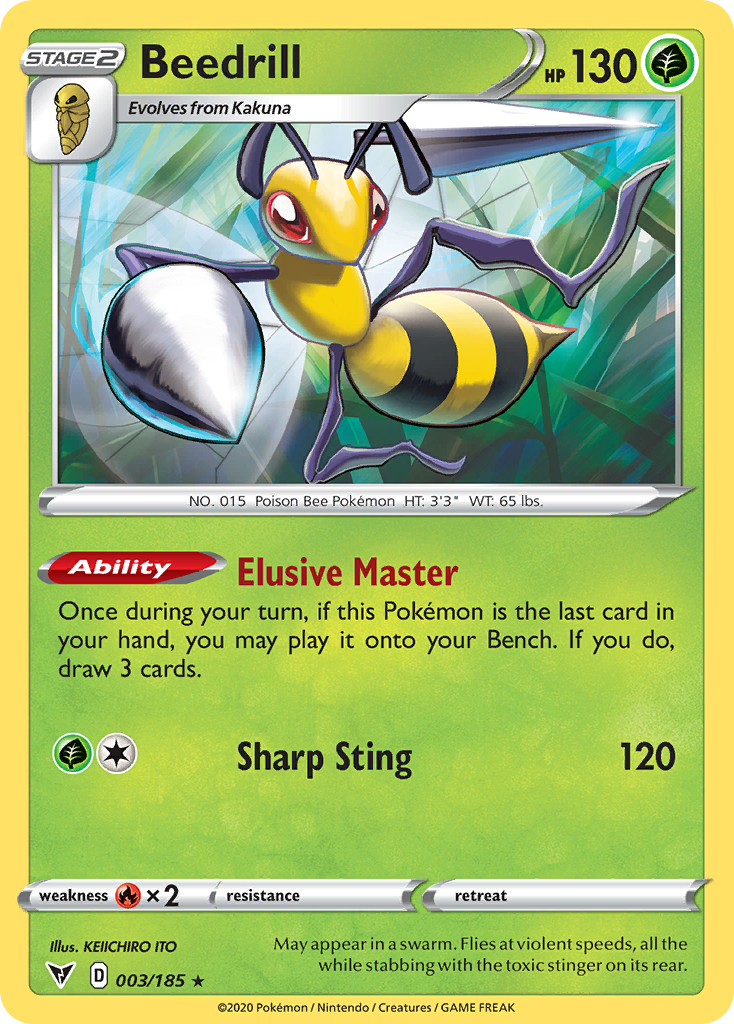
| Subtype | Stage 2 |
| HP | 130 |
| Types | Grass |
| Attack | Sharp Sting |
| Attack cost | Grass |
| Artist | KEIICHIRO ITO |
| Rarity | Rare |
| Pokédex | 15 |
| Evolves from | Kakuna |
Beedrill
May appear in a swarm. Flies at violent speeds, all the while stabbing with the toxic stinger on its rear.
Vendor Information
- Store Name: DutchGem
- Vendor: DutchGem
-
Address:
gekkestraat
179
2345GT Utrecht
Roaring Skies
It usually forages for food on the ground but may, on rare occasions, hop onto branches to peck at shoots.
Forbidden Light
Six of them together form a full-fledged Pokémon. It's often hunted by Crabrawler, but uses psychokinesis to drive it off.
Scarlet & Violet
These Pokémon make their nests on coastal cliffs. The nests have a strange, crackling texture, and they're a popular delicacy.
Sun & Moon
On moonless nights, Haunter searches for someone to curse, so it's best not to go out walking around.
Related products
Sword & Shield
With noises that could be mistaken for the rattles of maracas, it creates an upbeat rhythm, startling bird Pokémon and making them fly off in a hurry.
Sword & Shield
They lay their eggs deep inside their nests. When attacked by Heatmor, they retaliate using their massive mandibles.
Sword & Shield
As it grows inside its shell, it uses its psychic abilities to monitor the outside world and prepare for evolution.
Sword & Shield
Its flowers give off a relaxing fragrance. The stronger its aroma, the healthier the Roselia is.
Sword & Shield
It scatters cotton all over the place as a prank. If it gets wet, it'll become too heavy to move and have no choice but to answer for its mischief.
Sword & Shield
The cotton on the head of this Pokémon can be spun into a glossy, gorgeous yarn—a Galar regional specialty.
Sword & Shield
There's a hole in its tail that allows it to draw in the air it needs to keep its fire burning. If the hole gets blocked, this Pokémon will fall ill.
Sword & Shield
Its venom sacs produce a fluid that this Pokémon then heats up with the flame in its tail. This process creates Salandit's poisonous gas.