
| Supertype | Pokémon |
|---|---|
| Subtype | Basic |
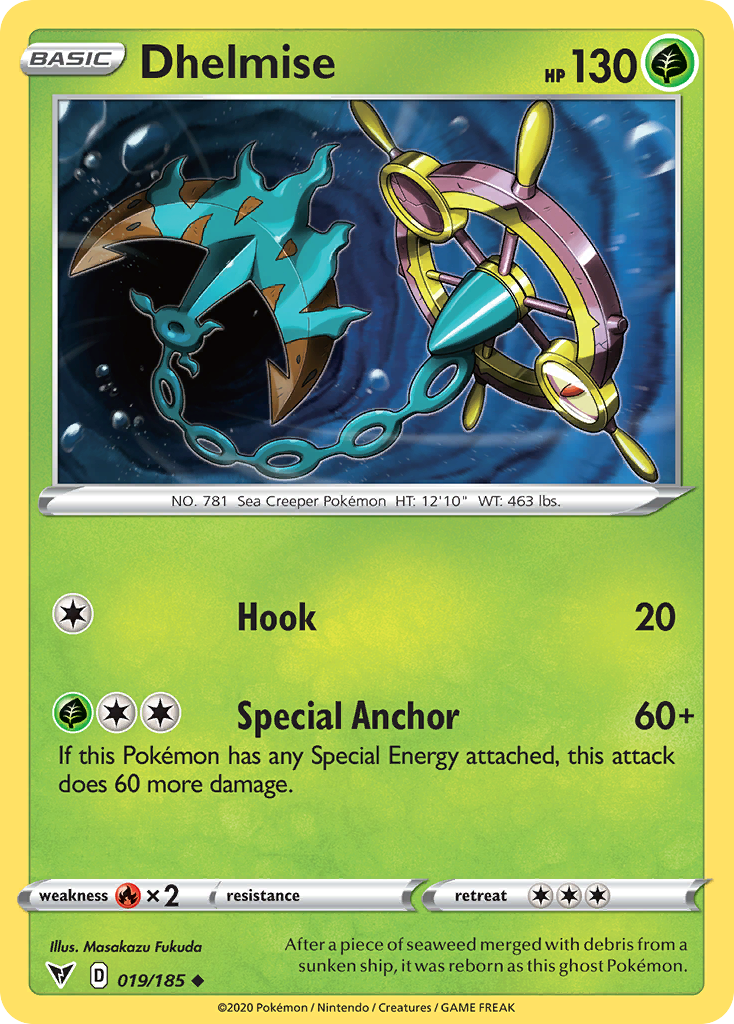
| HP | 130 |
| Types | Grass |
| Attack | Hook |
| Attack cost | Colorless |
| Artist | Masakazu Fukuda |
| Rarity | Uncommon |
| Pokédex | 781 |
Dhelmise
After a piece of seaweed merged with debris from a sunken ship, it was reborn as this ghost Pokémon.
Vendor Information
- Store Name: DutchGem
- Vendor: DutchGem
-
Address:
gekkestraat
179
2345GT Utrecht
Sun & Moon
It's protected by its hard sepals, so it plays with bird Pokémon without worry. They peck it relentlessly, but it doesn't care.
BREAKpoint
When it dangles from a tree branch, it looks just like an acorn. It enjoys scaring other Pokémon.
Paldean Fates
It swings its handmade hammer around to protect itself, but the hammer is often stolen by Pokémon that eat metal.
Evolving Skies
As soon as it's born, it burrows into an apple. Not only does the apple serve as its food source, but the flavor of the fruit determines its evolution.
Related products
Sword & Shield
Discard the top card of your deck. If that card is a Fire Energy card, this attack does 90 more damage.
Sword & Shield
When it uses its special stick to strike up a beat, the sound waves produced carry revitalizing energy to the plants and flowers in the area.
Sword & Shield
It shoots cotton from its body to protect itself. If it gets caught up in hurricane-strength winds, it can get sent to the other side of the Earth.
Sword & Shield
There's a hole in its tail that allows it to draw in the air it needs to keep its fire burning. If the hole gets blocked, this Pokémon will fall ill.
Sword & Shield
Only female Salazzle exist. They emit a gas laden with pheromones to captivate male Salandit.
Sword & Shield
It emits psychic energy to observe and study what's around it—and what's around it can include things over six miles away.
Sword & Shield
They lay their eggs deep inside their nests. When attacked by Heatmor, they retaliate using their massive mandibles.
Sword & Shield
Its venom sacs produce a fluid that this Pokémon then heats up with the flame in its tail. This process creates Salandit's poisonous gas.