
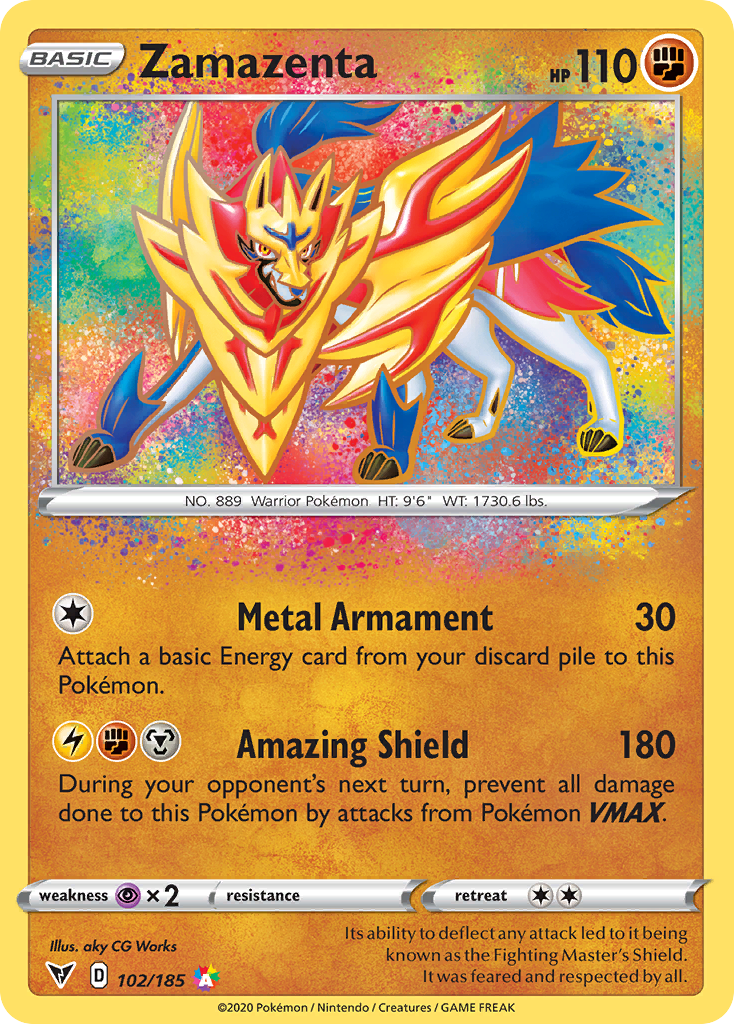
Attach a basic Energy card from your discard pile to this Pokémon.
Zamazenta
Its ability to deflect any attack led to it being known as the Fighting Master’s Shield. It was feared and respected by all.

| Supertype | Pokémon |
|---|---|
| Subtype | Basic |
| HP | 110 |
| Types | Fighting |
| Attack | Metal Armament |
| Attack cost | Colorless |
| Artist | aky CG Works |
| Rarity | Amazing Rare |
| Pokédex | 889 |
Informatie verkoper
- Shopnaam: DutchGem
- Verkoper DutchGem
-
Adres:
gekkestraat
179
2345GT Utrecht

Furious Fists
This attack does 180 damage minus 10 damage for each damage counter on this Pokémon.
Steam Siege
When it dangles from a tree branch, it looks just like an acorn. It enjoys scaring other Pokémon.
Base
Obviously prefers hot places. If it gets caught in the rain, steam is said to spout from the tip of its tail.
Evolving Skies
On occasion, their cries are sublimely pleasing to the ear. Palpitoad with larger lumps on their bodies can sing with a wider range of sounds.
Sun & Moon
Strong, but not too bright, this Pokémon can shatter even a skyscraper with its charging Tackles.
Gerelateerde producten
Sword & Shield
Attach up to 3 Fire Energy cards from your discard pile to your Pokémon in any way you like.
Sword & Shield
Its flowers give off a relaxing fragrance. The stronger its aroma, the healthier the Roselia is.
Sword & Shield
A constant collector of information, this Pokémon is very smart. Very strong is what it isn't.
Sword & Shield
Discard the top card of your deck. If that card is a Fire Energy card, this attack does 90 more damage.
Sword & Shield
The cotton on the head of this Pokémon can be spun into a glossy, gorgeous yarn—a Galar regional specialty.
Sword & Shield
When it uses its special stick to strike up a beat, the sound waves produced carry revitalizing energy to the plants and flowers in the area.
Sword & Shield
It is said to live 1,000 years, and each of its tails is loaded with supernatural powers.
Sword & Shield
Its venom sacs produce a fluid that this Pokémon then heats up with the flame in its tail. This process creates Salandit's poisonous gas.