
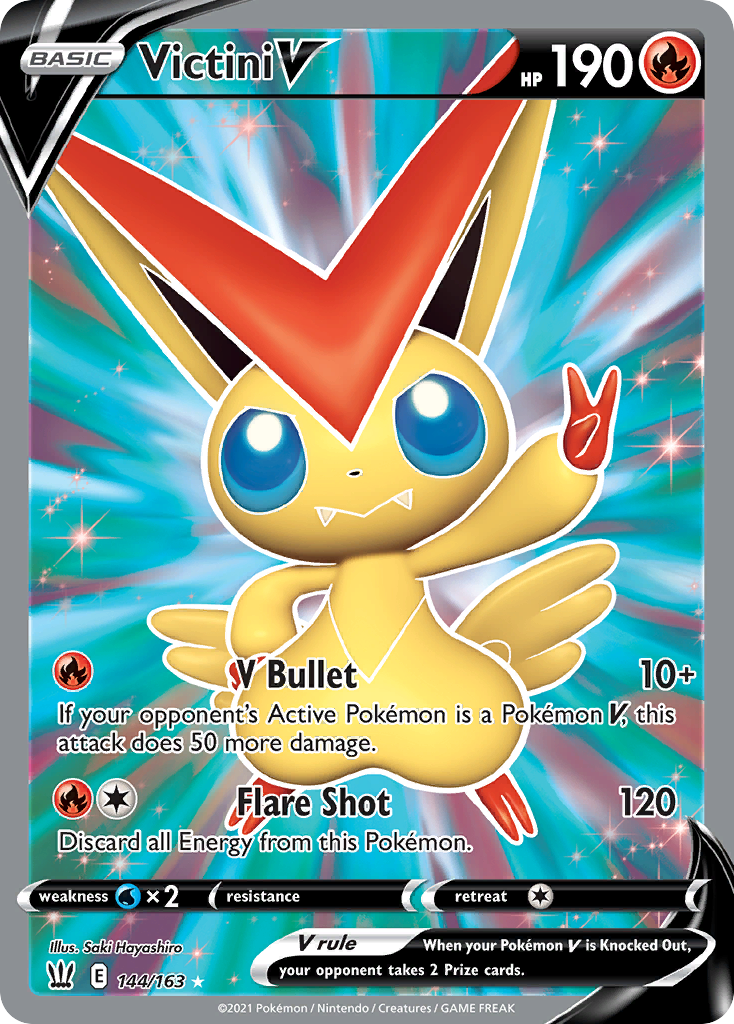


If your opponent’s Active Pokémon is a Pokémon V, this attack does 50 more damage.
| Supertype | Pokémon |
|---|---|
| Subtype | Basic |
| HP | 190 |
| Types | Fire |
| Attack | V Bullet |
| Attack cost | Fire |
| Artist | Saki Hayashiro |
| Rarity | Rare Ultra |
| Pokédex | 494 |
Informatie verkoper
- Shopnaam: DutchGem
- Verkoper DutchGem
-
Adres:
gekkestraat
179
2345GT Utrecht
Flashfire
It claims exquisite flower gardens as its territory, and it obtains power from basking in the energy emitted by flowering plants.
Base
Because it stores several kinds of toxic gases in its body, it is prone to exploding without warning.
Crimson Invasion
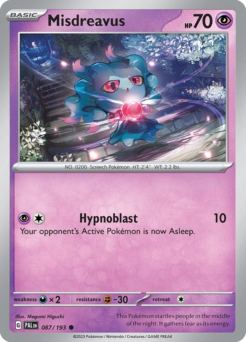
Singing in eerie voices, they wander town streets on the night of the new moon. Anyone who hears their song is cursed.
Scarlet & Violet
During your opponent’s next turn, this Pokémon takes 30 less damage from attacks (after applying Weakness and Resistance).
Scarlet & Violet
Flip a coin. If heads, choose 1 of your opponent’s Benched Pokémon. Shuffle that Pokémon and all attached cards into their deck.
Gerelateerde producten
Sword & Shield
A constant collector of information, this Pokémon is very smart. Very strong is what it isn't.
Sword & Shield
Often found in gardens, this Pokémon has hairs on its body that it uses to assess its surroundings.
Sword & Shield
They lay their eggs deep inside their nests. When attacked by Heatmor, they retaliate using their massive mandibles.
Sword & Shield
When it uses its special stick to strike up a beat, the sound waves produced carry revitalizing energy to the plants and flowers in the area.
Sword & Shield
The cotton on the head of this Pokémon can be spun into a glossy, gorgeous yarn—a Galar regional specialty.
Sword & Shield
The faster a Thwackey can beat out a rhythm with its two sticks, the more respect it wins from its peers.
Sword & Shield
When it uses its special stick to strike up a beat, the sound waves produced carry revitalizing energy to the plants and flowers in the area.
Sword & Shield
Its venom sacs produce a fluid that this Pokémon then heats up with the flame in its tail. This process creates Salandit's poisonous gas.