
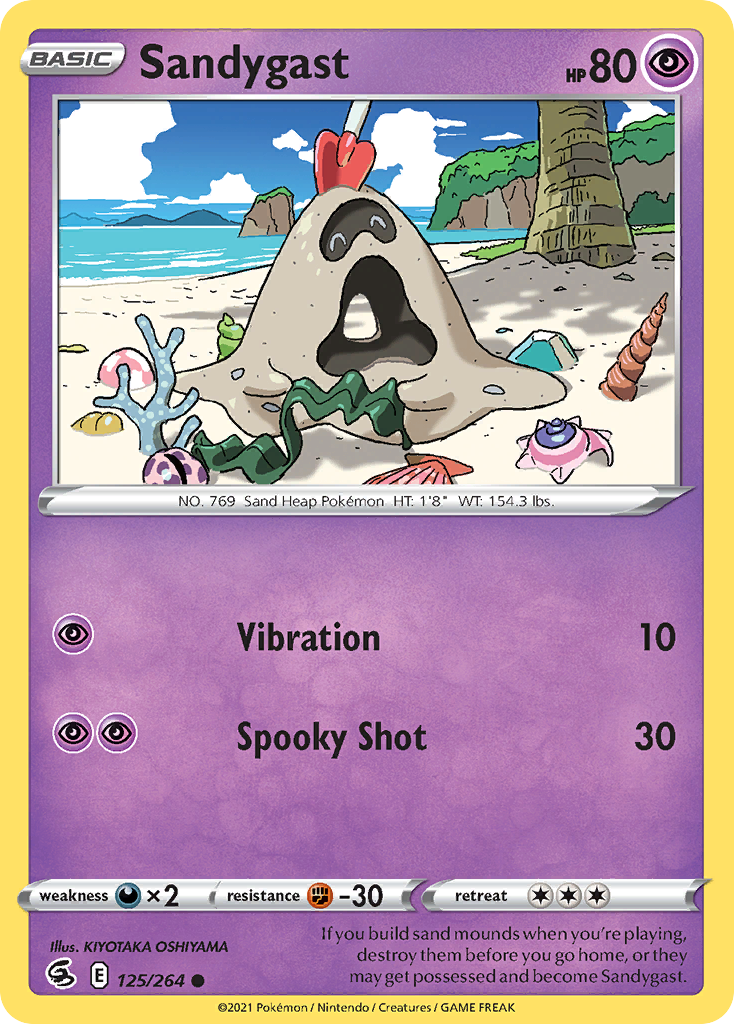
| Supertype | Pokémon |
|---|---|
| Subtype | Basic |
| HP | 80 |
| Types | Psychic |
| Attack | Vibration |
| Attack cost | Psychic |
| Artist | KIYOTAKA OSHIYAMA |
| Rarity | Common |
| Pokédex | 769 |
| Evolves to | Palossand |
Sandygast
If you build sand mounds when you’re playing, destroy them before you go home, or they may get possessed and become Sandygast.
Informatie verkoper
- Shopnaam: DutchGem
- Verkoper DutchGem
-
Adres:
gekkestraat
179
2345GT Utrecht
Primal Clash
It generates ultrasonic waves by violently flapping its wings. After making its prey faint, it melts the prey with acid.
Celestial Storm
It is said to have widened the seas by causing downpours. It had been asleep in a marine trench.
Chilling Reign
Its mane shines when it discharges electricity. They use the frequency and rhythm of these flashes to communicate.
Scarlet & Violet
With its herculean powers, it can easily throw around an object that is 100 times its own weight.
Sun & Moon
This attack does 20 more damage times the amount of Water Energy attached to your Pokémon.
Gerelateerde producten
Sword & Shield
Its flowers give off a relaxing fragrance. The stronger its aroma, the healthier the Roselia is.
Sword & Shield
They lay their eggs deep inside their nests. When attacked by Heatmor, they retaliate using their massive mandibles.
Sword & Shield
When it uses its special stick to strike up a beat, the sound waves produced carry revitalizing energy to the plants and flowers in the area.
Sword & Shield
It emits psychic energy to observe and study what's around it—and what's around it can include things over six miles away.
Sword & Shield
Only female Salazzle exist. They emit a gas laden with pheromones to captivate male Salandit.
Sword & Shield
A constant collector of information, this Pokémon is very smart. Very strong is what it isn't.
Sword & Shield
The faster a Thwackey can beat out a rhythm with its two sticks, the more respect it wins from its peers.
Sword & Shield
Its venom sacs produce a fluid that this Pokémon then heats up with the flame in its tail. This process creates Salandit's poisonous gas.