
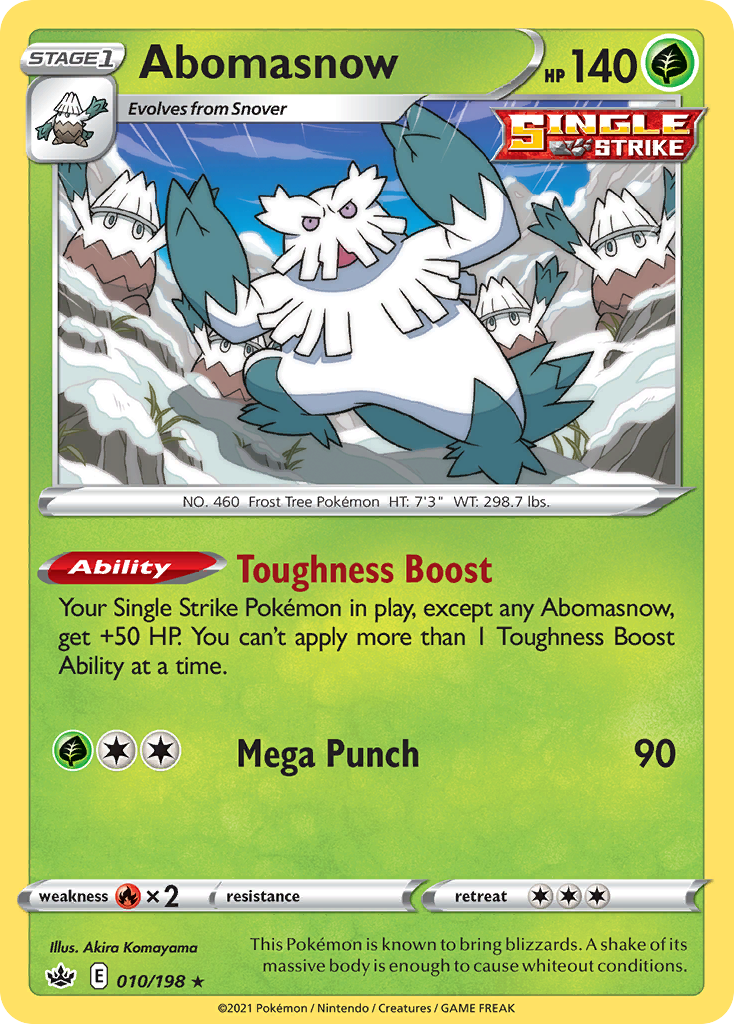
| Supertype | Pokémon |
|---|---|
| Subtype | Stage 1 |
| HP | 140 |
| Types | Grass |
| Attack | Mega Punch |
| Attack cost | Grass |
| Artist | Akira Komayama |
| Rarity | Rare |
| Pokédex | 460 |
| Evolves from | Snover |
Abomasnow
This Pokémon is known to bring blizzards. A shake of its massive body is enough to cause whiteout conditions.
Informatie verkoper
- Shopnaam: DutchGem
- Verkoper DutchGem
-
Adres:
gekkestraat
179
2345GT Utrecht
Lost Thunder
This attack does 30 damage to 1 of your opponent’s Benched Pokémon. (Don’t apply Weakness and Resistance for Benched Pokémon.)
Obsidian Flames
It is said that this Pokémon was born when an unknown poison Pokémon entered and inspirited an engine left at a scrap-processing factory.
Scarlet & Violet
When it flies to this land from across the sea, the bitter winter comes to an end. According to legend, this Pokémon's love gives rise to the budding of fresh life across Hisui.
Sun & Moon
Its stomach takes up most of its long torso. It's a big eater, so the amount Trainers have to spend on its food is no laughing matter.
Gerelateerde producten
Sword & Shield
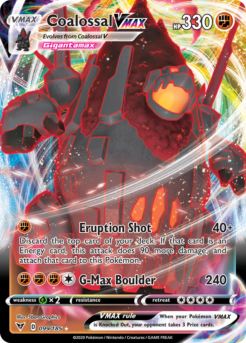
Discard the top card of your deck. If that card is a Fire Energy card, this attack does 90 more damage.
Sword & Shield
A constant collector of information, this Pokémon is very smart. Very strong is what it isn't.
Sword & Shield
It emits psychic energy to observe and study what's around it—and what's around it can include things over six miles away.
Sword & Shield
After captivating opponents with its sweet scent, it lashes them with its thorny whips.
Sword & Shield
The faster a Thwackey can beat out a rhythm with its two sticks, the more respect it wins from its peers.
Sword & Shield
The cotton on the head of this Pokémon can be spun into a glossy, gorgeous yarn—a Galar regional specialty.
Sword & Shield
When it uses its special stick to strike up a beat, the sound waves produced carry revitalizing energy to the plants and flowers in the area.
Sword & Shield
Its venom sacs produce a fluid that this Pokémon then heats up with the flame in its tail. This process creates Salandit's poisonous gas.