

| Supertype | Pokémon |
|---|---|
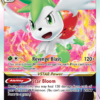
| Subtype | Basic |
| HP | 190 |
| Types | Grass |
| Attack | Flap |
| Attack cost | Grass |
| Artist | Satoshi Shirai |
| Rarity | Rare Holo V |
| Pokédex | 492 |
Vendor Information
- Store Name: DutchGem
- Vendor: DutchGem
-
Address:
gekkestraat
179
2345GT Utrecht
Hidden Fates
The latest research has determined that there are over 20 possible arrangements of the patterns on its stomach.
Chilling Reign
The small spikes covering its body developed from scales. They inject a toxin that causes fainting.
Lost Origin
The temperature of its breath is over 10,000 degrees Fahrenheit, but Pyroar doesn't use it on its prey. This Pokémon prefers to eat raw meat.
Scarlet & Violet
It can generate and release gas within its body. That's how it can control the altitude of its drift.
Obsidian Flames
This attack does 40 more damage for each of your Benched Pokémon that has any Grass Energy attached.
Sun & Moon
It lived in the same environments as Rampardos. Their fossils have been found together—seemingly from after they'd fought to the finish.
מוצרים קשורים
Sword & Shield
It emits psychic energy to observe and study what's around it—and what's around it can include things over six miles away.
Sword & Shield
Search your deck for up to 2 Pokémon, reveal them, and put them into your hand. Then, shuffle your deck.
Sword & Shield
The faster a Thwackey can beat out a rhythm with its two sticks, the more respect it wins from its peers.
Sword & Shield
The faster a Thwackey can beat out a rhythm with its two sticks, the more respect it wins from its peers.
Sword & Shield
It scatters cotton all over the place as a prank. If it gets wet, it'll become too heavy to move and have no choice but to answer for its mischief.
Sword & Shield
Its flowers give off a relaxing fragrance. The stronger its aroma, the healthier the Roselia is.
Sword & Shield
Attach up to 3 Fire Energy cards from your discard pile to your Pokémon in any way you like.
Sword & Shield
Its venom sacs produce a fluid that this Pokémon then heats up with the flame in its tail. This process creates Salandit's poisonous gas.