



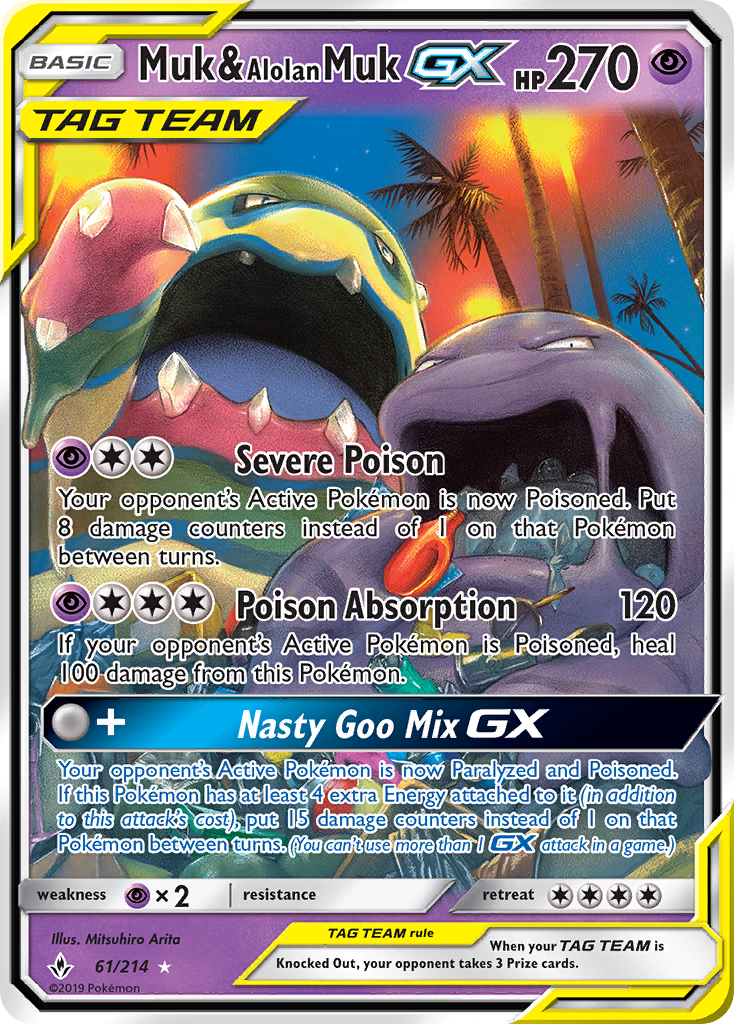
Your opponent's Active Pokémon is now Poisoned. Put 8 damage counters instead of 1 on that Pokémon between turns.
| Supertype | Pokémon |
|---|---|
| Subtype | Basic |
| HP | 270 |
| Types | Psychic |
| Attack | Severe Poison |
| Attack cost | Psychic |
| Artist | Mitsuhiro Arita |
| Rarity | Rare Holo GX |
| Pokédex | 89 |
Vendor Information
- Store Name: DutchGem
- Vendor: DutchGem
-
Address:
gekkestraat
179
2345GT Utrecht
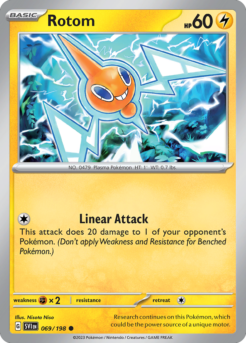
Scarlet & Violet
Research continues on this Pokémon, which could be the power source of a unique motor.
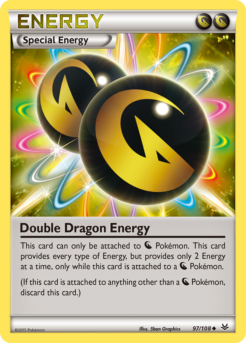
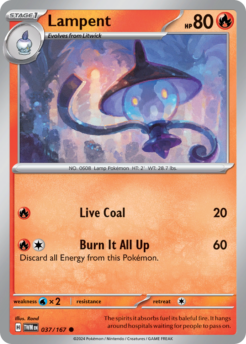
Scarlet & Violet
The spirits it absorbs fuel its baleful fire. It hangs around hospitals waiting for people to pass on.
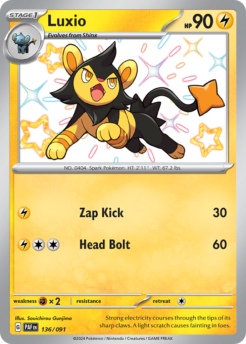
Paldean Fates
Strong electricity courses through the tips of its sharp claws. A light scratch causes fainting in foes.
151
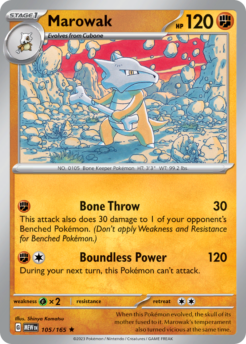
When this Pokémon evolved, the skull of its mother fused to it. Marowak's temperament also turned vicious at the same time.
Sun & Moon
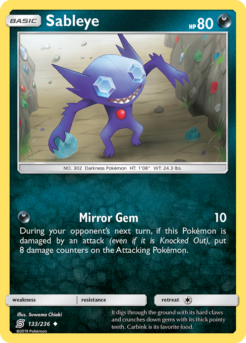
It digs through the ground with its hard claws and crunches down gems with its thick pointy teeth. Carbink is its favorite food.