
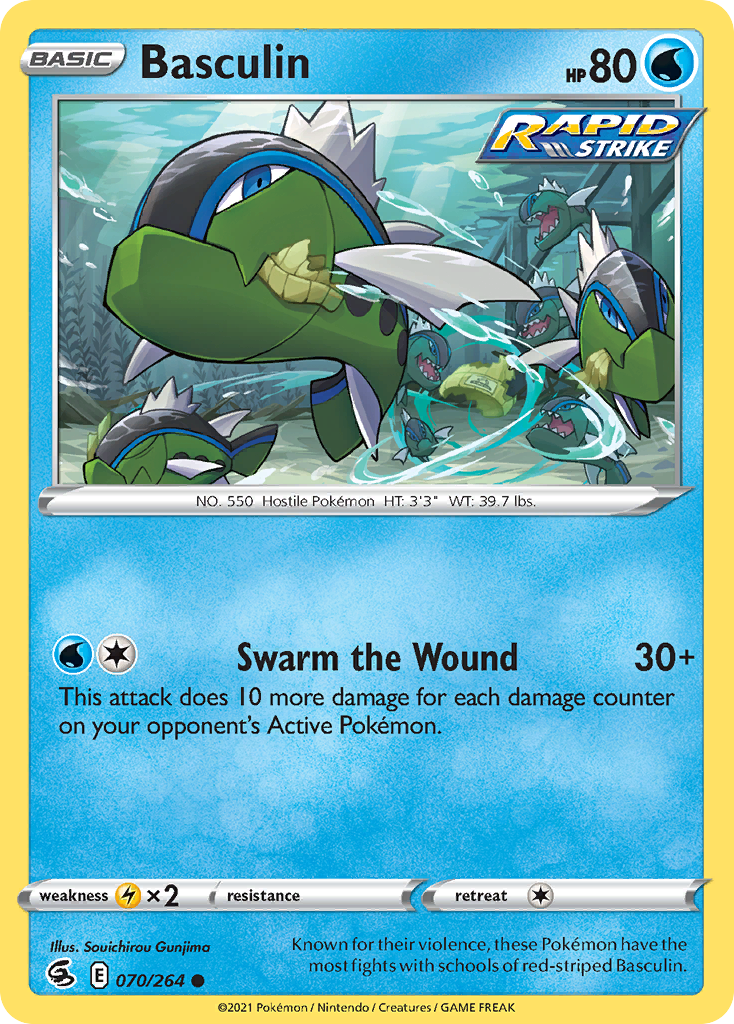
This attack does 10 more damage for each damage counter on your opponent's Active Pokémon.
Basculin
Known for their violence, these Pokémon have the most fights with schools of red-striped Basculin.
| Supertype | Pokémon |
|---|---|
| Subtype | Basic |
| HP | 80 |
| Types | Water |
| Attack | Swarm the Wound |
| Attack cost | Water |
| Artist | Souichirou Gunjima |
| Rarity | Common |
| Pokédex | 550 |
Vendor Information
- Store Name: DutchGem
- Vendor: DutchGem
-
Address:
gekkestraat
179
2345GT Utrecht
Lost Origin
This is a Porygon that was updated with special data. Porygon2 develops itself by learning about many different subjects all on its own.
Scarlet & Violet
It has a small stomach. If it isn't constantly eating the seeds it keeps in its pockets, it will get hungry immediately.
Chilling Reign
This attack does 30 more damage for each Psychic Energy attached to all of your Pokémon.
Sword & Shield
If it builds up enough speed swimming, it can jump out above the waves and glide for over 300 feet.
מוצרים קשורים
Sword & Shield
Its flowers give off a relaxing fragrance. The stronger its aroma, the healthier the Roselia is.
Sword & Shield
As it grows inside its shell, it uses its psychic abilities to monitor the outside world and prepare for evolution.
Sword & Shield
While young, it has six gorgeous tails. When it grows, several new tails are sprouted.
Sword & Shield
It scatters cotton all over the place as a prank. If it gets wet, it'll become too heavy to move and have no choice but to answer for its mischief.
Sword & Shield
It whirls around in the wind while singing a joyous song. This delightful display has charmed many into raising this Pokémon.
Sword & Shield
Its flowers give off a relaxing fragrance. The stronger its aroma, the healthier the Roselia is.
Sword & Shield
With noises that could be mistaken for the rattles of maracas, it creates an upbeat rhythm, startling bird Pokémon and making them fly off in a hurry.
Sword & Shield
Its venom sacs produce a fluid that this Pokémon then heats up with the flame in its tail. This process creates Salandit's poisonous gas.