

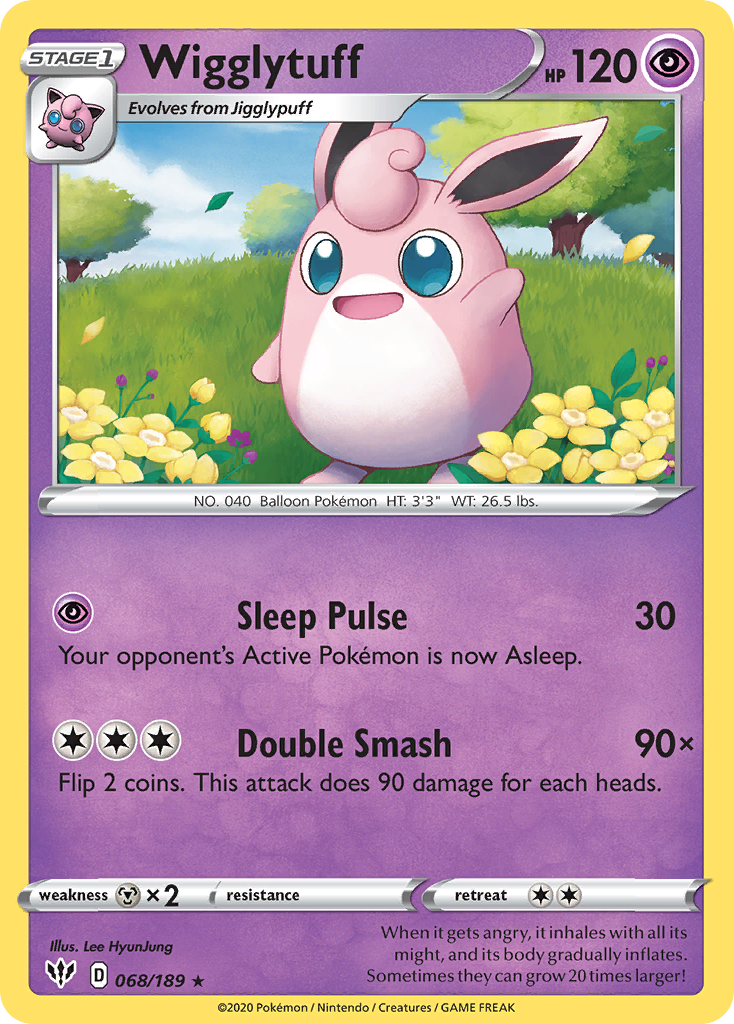


Your opponent's Active Pokémon is now Asleep.
Wigglytuff
When it gets angry, it inhales with all its might, and its body gradually inflates. Sometimes they can grow 20 times larger!

| Supertype | Pokémon |
|---|---|
| Subtype | Stage 1 |
| HP | 120 |
| Types | Psychic |
| Attack | Sleep Pulse |
| Attack cost | Psychic |
| Artist | Lee HyunJung |
| Rarity | Rare |
| Pokédex | 40 |
| Evolves from | Jigglypuff |
Vendor Information
- Store Name: DutchGem
- Vendor: DutchGem
-
Address:
gekkestraat
179
2345GT Utrecht
Sun & Moon
It has no eyeballs, so it can't see. It checks its surroundings via the ultrasonic waves it emits from its mouth.
Fusion Strike
It booms out a victory croak when its prey goes down in defeat. This Pokémon and Seismitoad are related species.
Battle Styles
They thump their bones rhythmically to communicate among themselves. There are nearly 50 different rhythmic patterns.
Chilling Reign
It is usually motionless, but when attacked, it rotates at high speed and then crashes into its opponent.
מוצרים קשורים
Sword & Shield
Search your deck for up to 2 Pokémon, reveal them, and put them into your hand. Then, shuffle your deck.
Sword & Shield
Its flowers give off a relaxing fragrance. The stronger its aroma, the healthier the Roselia is.
Sword & Shield
Discard the top card of your deck. If that card is a Fire Energy card, this attack does 90 more damage.
Sword & Shield
They lay their eggs deep inside their nests. When attacked by Heatmor, they retaliate using their massive mandibles.
Sword & Shield
It shoots cotton from its body to protect itself. If it gets caught up in hurricane-strength winds, it can get sent to the other side of the Earth.
Sword & Shield
When it uses its special stick to strike up a beat, the sound waves produced carry revitalizing energy to the plants and flowers in the area.
Sword & Shield
Often found in gardens, this Pokémon has hairs on its body that it uses to assess its surroundings.
Sword & Shield
Its venom sacs produce a fluid that this Pokémon then heats up with the flame in its tail. This process creates Salandit's poisonous gas.