
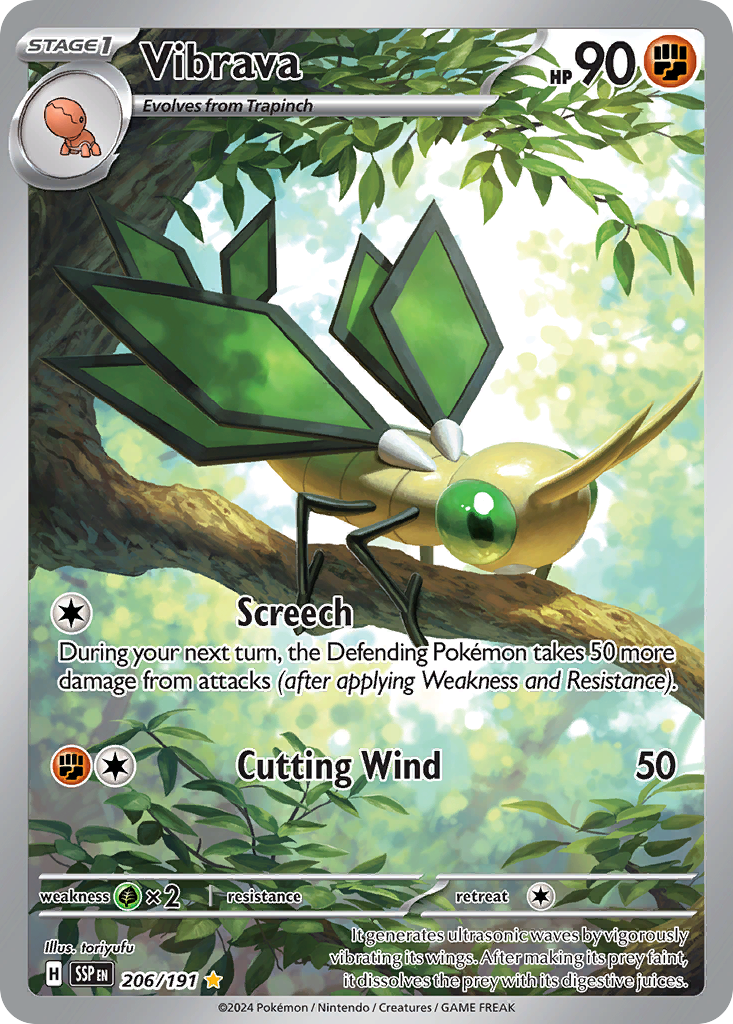

During your next turn, the Defending Pokémon takes 50 more damage from attacks (after applying Weakness and Resistance).
| Supertype | Pokémon |
|---|---|
| Subtype | Stage 1 |
| HP | 90 |
| Types | Fighting |
| Attack | Screech |
| Attack cost | Colorless |
| Rarity | Illustration Rare |
| Pokédex | 329 |
| Evolves from | Trapinch |
| Evolves to | Flygon |
Vendor Information
- Store Name: DutchGem
- Vendor: DutchGem
-
Address:
gekkestraat
179
2345GT Utrecht
Brilliant Stars
Before doing damage, discard all Pokémon Tools from your opponent's Active Pokémon.
Scarlet & Violet
It builds up electricity in its abdomen, focuses it through its jaws, and then fires the electricity off in concentrated beams.
Evolutions
May appear in a swarm. Flies at violent speeds, all the while stabbing with the toxic stinger on its rear.
Darkness Ablaze
They are better at swimming than flying, and they happily eat their favorite food, peat moss, as they dive underwater.
מוצרים קשורים
Scarlet & Violet
This Pokémon uses the reflective fur lining its cape to camouflage the stem of its flower, creating the illusion that the flower is floating.
Scarlet & Violet
Its fluffy fur is similar in composition to plants. This Pokémon frequently washes its face to keep it from drying out.
Scarlet & Violet
It protects itself from enemies by emitting oil from the fruit on its head. This oil is bitter and astringent enough to make someone flinch.
Scarlet & Violet
Floragato deftly wields the vine hidden beneath its long fur, slamming the hard flower bud against its opponents.
Scarlet & Violet
It protects itself from enemies by emitting oil from the fruit on its head. This oil is bitter and astringent enough to make someone flinch.
Scarlet & Violet
It prefers damp places. By day it remains still in the forest shade. It releases toxic powder from its head.
Scarlet & Violet
Dolliv shares its tasty, fresh-scented oil with others. This species has coexisted with humans since times long gone.
Scarlet & Violet
It can sense the feelings of others by touching them with its horns. This species has assisted people with their work since 5,000 years ago.