
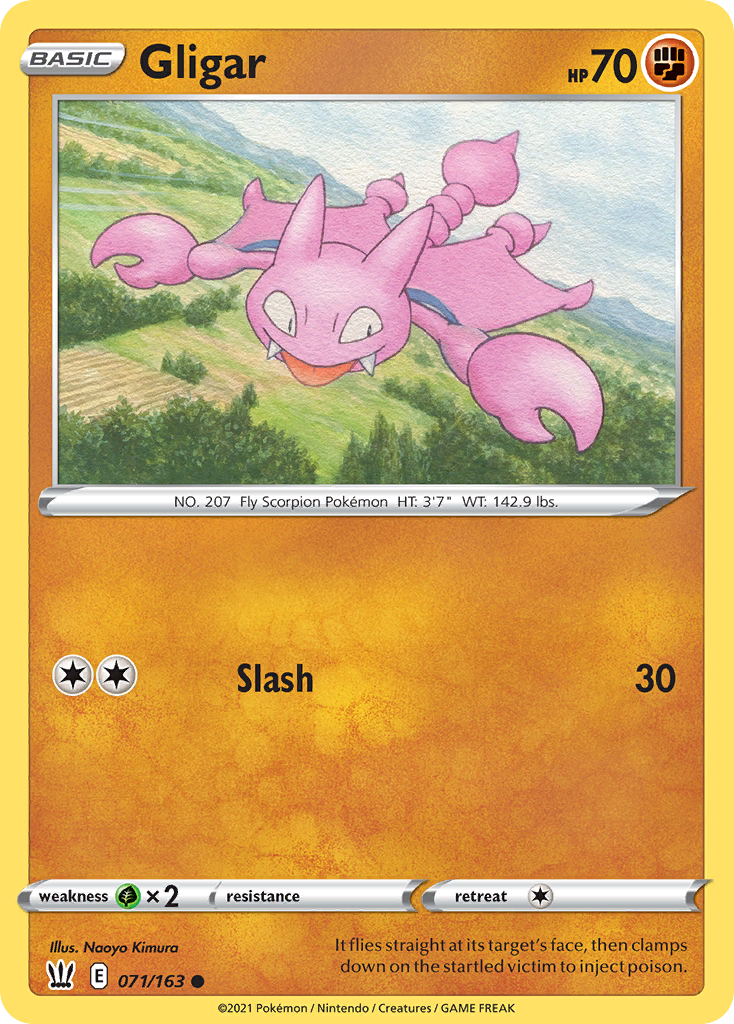
| Supertype | Pokémon |
|---|---|
| Subtype | Basic |
| HP | 70 |
| Types | Fighting |
| Attack | Slash |
| Attack cost | Colorless |
| Artist | Naoyo Kimura |
| Rarity | Common |
| Pokédex | 207 |
| Evolves to | Gliscor |
Gligar
It flies straight at its target’s face then clamps down on the startled victim to inject poison.
Vendor Information
- Store Name: DutchGem
- Vendor: DutchGem
-
Address:
gekkestraat
179
2345GT Utrecht

Paldean Fates
Very protective of its sprawling territorial area, this Pokémon will fiercely peck at any intruder.
Evolving Skies
On occasion, their cries are sublimely pleasing to the ear. Palpitoad with larger lumps on their bodies can sing with a wider range of sounds.
Scarlet & Violet
It lives along water in forests. In the daytime, it leaves the forest to sunbathe its treed shell.
151
The wings are covered with dustlike scales. Every time it flaps its wings, it looses highly toxic dust.
Phantom Forces
This Pokémon appears before people and Pokémon who are having nightmares and eats those dreams.
Tutustu myös
Sword & Shield
Its flowers give off a relaxing fragrance. The stronger its aroma, the healthier the Roselia is.
Sword & Shield
If any of your Grass Pokémon were Knocked Out by damage from an opponent’s attack during their last turn, this attack does 90 more damage.
Sword & Shield
It emits psychic energy to observe and study what's around it—and what's around it can include things over six miles away.
Sword & Shield
While young, it has six gorgeous tails. When it grows, several new tails are sprouted.
Sword & Shield
As it grows inside its shell, it uses its psychic abilities to monitor the outside world and prepare for evolution.
Sword & Shield
When it uses its special stick to strike up a beat, the sound waves produced carry revitalizing energy to the plants and flowers in the area.
Sword & Shield
The cotton on the head of this Pokémon can be spun into a glossy, gorgeous yarn—a Galar regional specialty.
Sword & Shield
Its venom sacs produce a fluid that this Pokémon then heats up with the flame in its tail. This process creates Salandit's poisonous gas.