
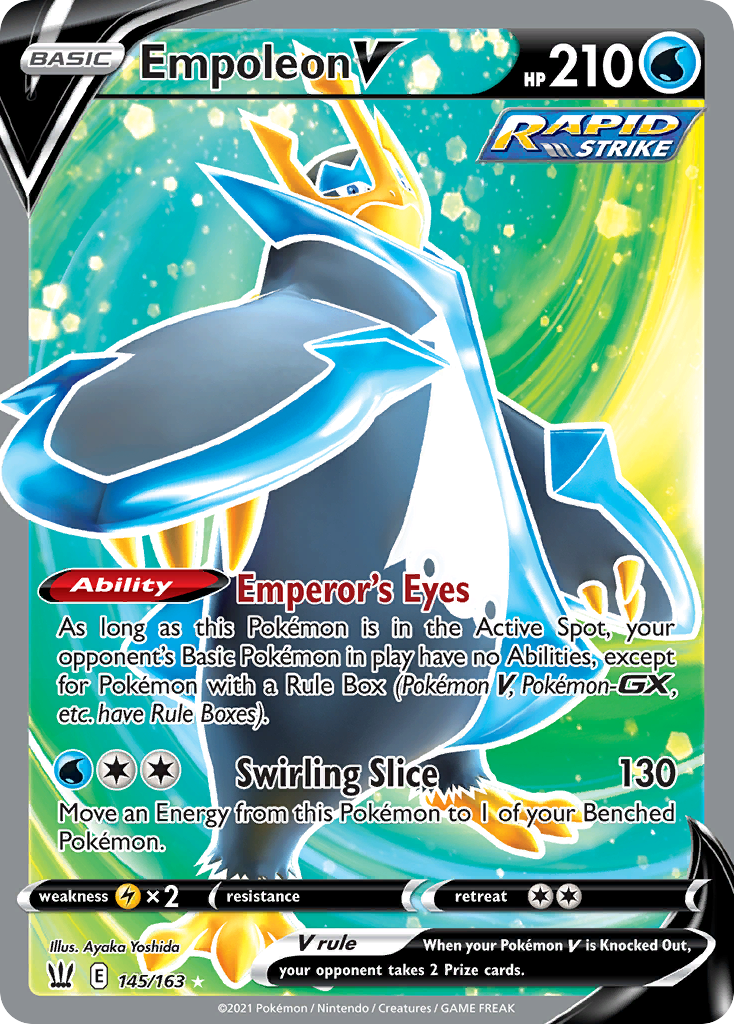

Move an Energy from this Pokémon to 1 of your Benched Pokémon.
| Supertype | Pokémon |
|---|---|
| Subtype | Basic |
| HP | 210 |
| Types | Water |
| Attack | Swirling Slice |
| Attack cost | Water |
| Artist | Ayaka Yoshida |
| Rarity | Rare Ultra |
| Pokédex | 395 |
Vendor Information
- Store Name: DutchGem
- Vendor: DutchGem
-
Address:
gekkestraat
179
2345GT Utrecht
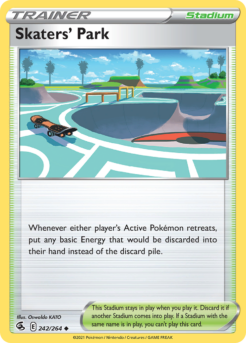
Paldean Fates
It's small and its electricity-generating organ is not fully developed, so it uses its tail to absorb electricity from people's homes and charge itself.
Scarlet & Violet
It freezes prey by blowing its −58 degree Fahrenheit breath. It is said to then secretly display its prey.
Primal Clash
Heal from this Pokémon the same amount of damage you did to your opponent’s Active Pokémon.
Sword & Shield
Usually found in power plants. Easily mistaken for a Poké Ball, it has zapped many people.
Sun & Moon
Search your deck for up to 2 cards and put them into your hand. Then, shuffle your deck.
Scarlet & Violet
It spends even the smallest amount of downtime grooming its fur with its tongue. Loose fur gathers in its stomach and serves as fuel for fiery moves.
Tutustu myös
Sword & Shield
It is said to live 1,000 years, and each of its tails is loaded with supernatural powers.
Sword & Shield
While young, it has six gorgeous tails. When it grows, several new tails are sprouted.
Sword & Shield
A constant collector of information, this Pokémon is very smart. Very strong is what it isn't.
Sword & Shield
After captivating opponents with its sweet scent, it lashes them with its thorny whips.
Sword & Shield
The faster a Thwackey can beat out a rhythm with its two sticks, the more respect it wins from its peers.
Sword & Shield
They lay their eggs deep inside their nests. When attacked by Heatmor, they retaliate using their massive mandibles.
Sword & Shield
It whirls around in the wind while singing a joyous song. This delightful display has charmed many into raising this Pokémon.
Sword & Shield
Its venom sacs produce a fluid that this Pokémon then heats up with the flame in its tail. This process creates Salandit's poisonous gas.