
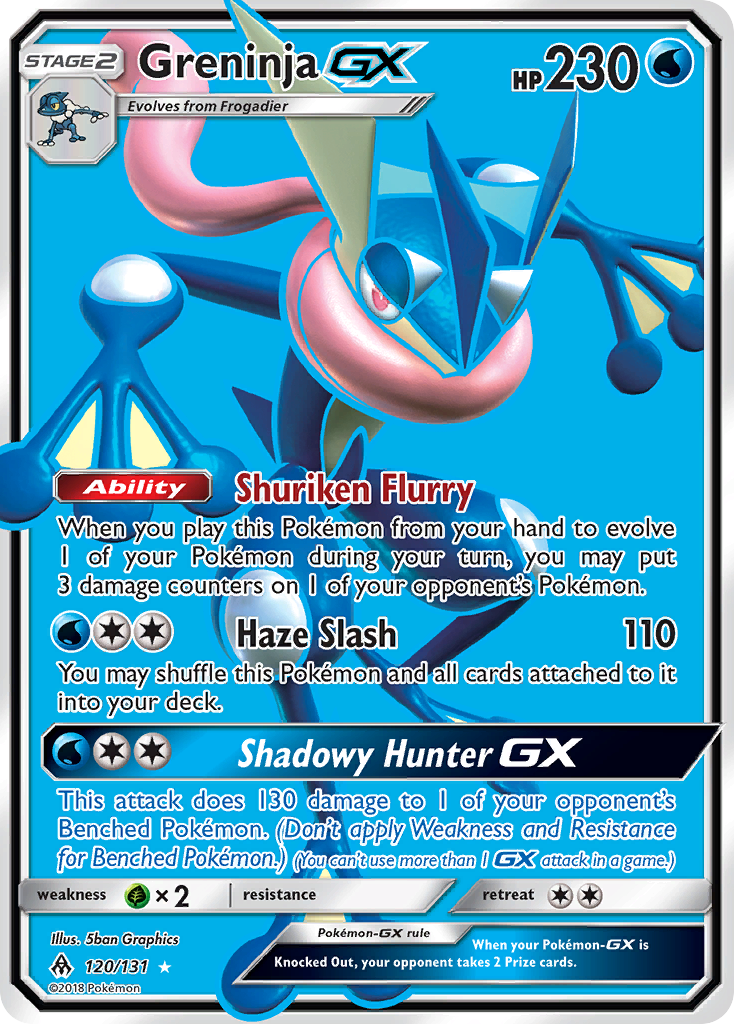

You may shuffle this Pokémon and all cards attached to it into your deck.
| Supertype | Pokémon |
|---|---|
| Subtype | Stage 2 |
| HP | 230 |
| Types | Water |
| Attack | Haze Slash |
| Attack cost | Water |
| Artist | 5ban Graphics |
| Rarity | Rare Ultra |
| Pokédex | 658 |
| Evolves from | Frogadier |
Información del vendedor
- Nombre de la tienda: DutchGem
- Vendedor: DutchGem
-
Dirección:
gekkestraat
179
2345GT Utrecht

Sun & Moon
When attacked by bird Pokémon, it resists by releasing a terrifically strong odor from its antennae, but it often becomes their prey.
Battle Styles
To make itself appear intimidatingly beefy, it tightly cinches its waist with its twin tails.
Paldean Fates
This cunning Pokémon hides under the cover of darkness, waiting to attack its prey.
Paldea Evolved
This Pokémon uses its hard tail to make its nest by boring holes into bedrock deep underground. The nest can reach lengths of over six miles.
Steam Siege
Discard as many of your Benched Pokémon as you like. This attack does 10 more damage for each Benched Pokémon you discarded in this way.
Productos relacionados
Sun & Moon
Its long, striking legs aren't just for show but to be used to kick with skill. In victory, it shows off by kicking the defeated, laughing boisterously.
Sun & Moon
It fires arrow quills from its wings with such precision, they can pierce a pebble at distances over a hundred yards.
Sun & Moon
As a result of headaches so fierce they cause it to cry, it sometimes uses psychokinesis without meaning to.
Sun & Moon
They give off a sweet and refreshing scent. Cutiefly often gather near the tall grass where Fomantis are hiding.
Sun & Moon
The sepals on its head developed to protect its body. These are quite hard, so even if pecked by bird Pokémon, this Pokémon is totally fine.
Sun & Moon
It emits flickering spores that cause drowsiness. When its prey succumb to sleep, this Pokémon feeds on them by sucking in their energy.
Sun & Moon
When attacked by bird Pokémon, it resists by releasing a terrifically strong odor from its antennae, but it often becomes their prey.