
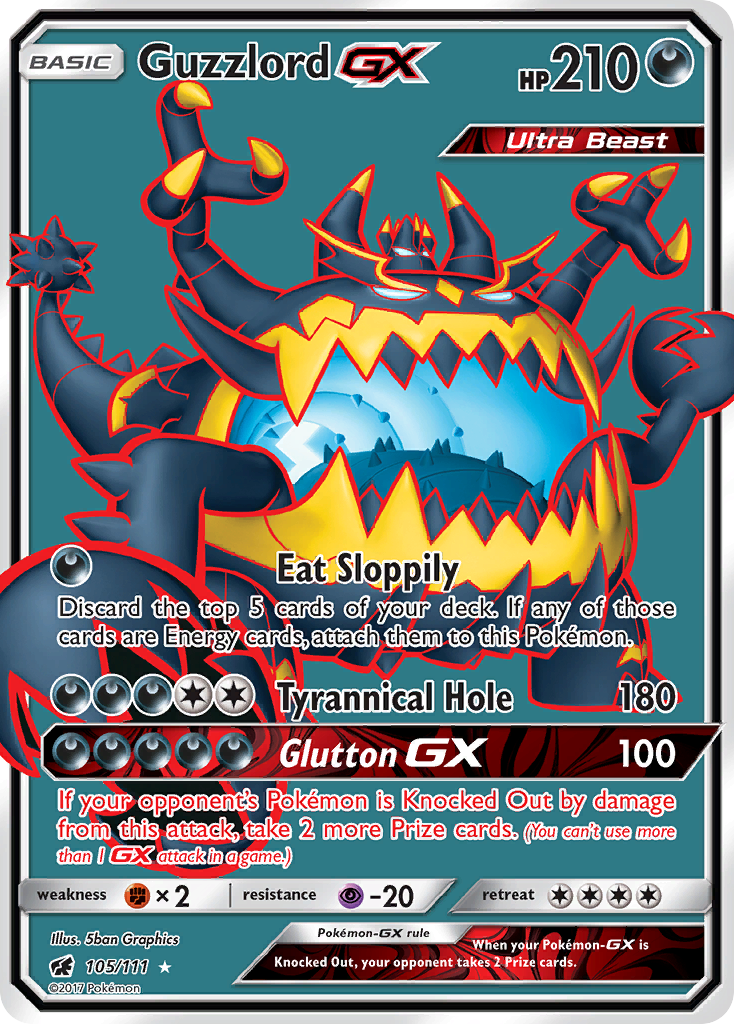
Discard the top 5 cards of your deck. If any of those cards are Energy cards, attach them to this Pokémon.
| Supertype | Pokémon |
|---|---|
| Subtype | Basic |
| HP | 210 |
| Types | Darkness |
| Attack | Eat Sloppily |
| Attack cost | Darkness |
| Artist | 5ban Graphics |
| Rarity | Rare Ultra |
| Pokédex | 799 |
Información del vendedor
- Nombre de la tienda: DutchGem
- Vendedor: DutchGem
-
Dirección:
gekkestraat
179
2345GT Utrecht
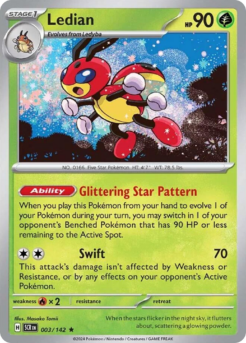
Darkness Ablaze
This attack does 30 damage to each of your opponent’s Pokémon. (Don’t apply Weakness and Resistance for Benched Pokémon.)
BREAKthrough
They inhabit mountainous regions. The leader of the herd is decided by a battle of clashing horns.
Lost Origin
It can be found in quiet mountain areas on a full moon's night. Its dancing and its tiny, faintly glowing wings confer upon it a lovely fairylike quality.
151
When it is angered, it immediately discharges the energy stored in the pouches in its cheeks.
Crimson Invasion
Its humped back stores intensely hot magma. In rain, the magma cools, slowing its movement.
Productos relacionados
Sun & Moon
Its wings and antennae don't cope well with moisture. After a rain, it faces sunward to dry off.
Sun & Moon
Attach 2 basic Energy cards from your discard pile to your Pokémon in any way you like.
Sun & Moon
As it drowses the day away, it nourishes itself by sucking from tree roots. It wakens at the fall of night, wandering off in search of a new tree.
Sun & Moon
A bit of a dandy, it spends its free time preening its wings. Its preoccupation with any dirt on its plumage can leave it unable to battle.
Sun & Moon
It is said that the red part of its forehead grants supernatural powers to those who posses one, so it was over-hunted in the past.
Sun & Moon
One solid blow from its horns is enough to split apart a large tree. Its greatest rival in Alola is Vikavolt.
Sun & Moon
When this Pokémon senses danger, a sweet fluid oozes from the tip of its heads. The taste of it disgusts bird Pokémon.
Sun & Moon
No matter how much it eats, the mushrooms growing on its back steal away most of the nutrients it consumes.