
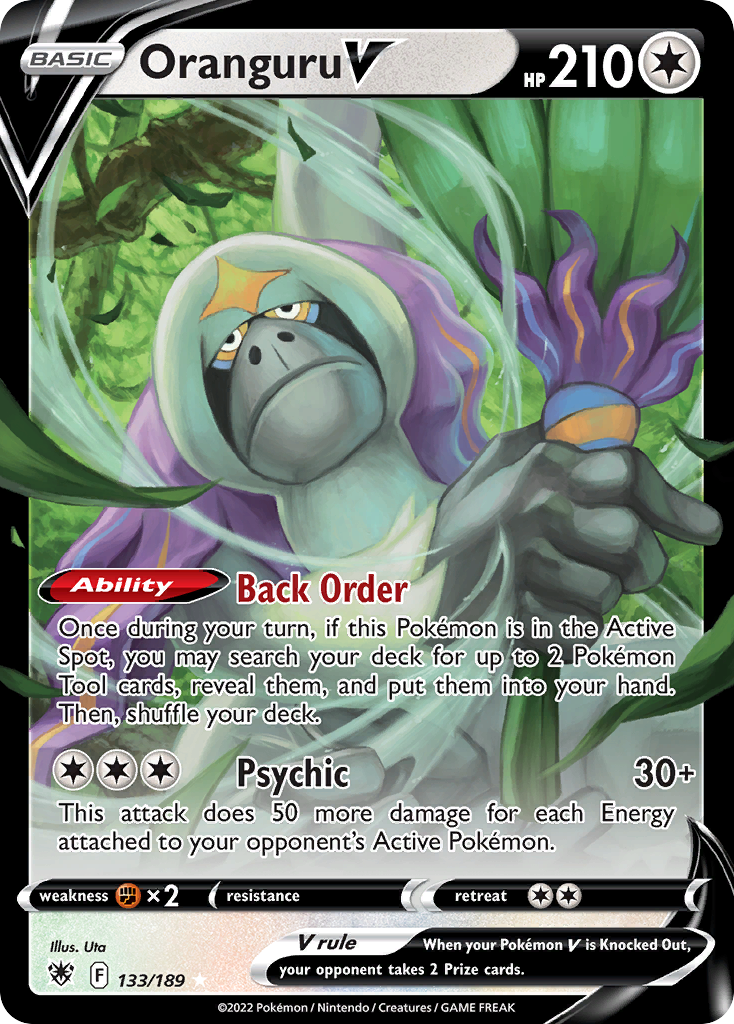
This attack does 50 more damage for each Energy attached to your opponent’s Active Pokémon.
| Supertype | Pokémon |
|---|---|
| Subtype | Basic |
| HP | 210 |
| Types | Colorless |
| Attack | Psychic |
| Attack cost | Colorless |
| Artist | Uta |
| Rarity | Rare Holo V |
| Pokédex | 765 |
Información del vendedor
- Nombre de la tienda: DutchGem
- Vendedor: DutchGem
-
Dirección:
gekkestraat
179
2345GT Utrecht
Scarlet & Violet
Your opponent’s Active Pokémon is now Burned. During your opponent’s next turn, that Pokémon can’t retreat.
Scarlet & Violet
This attack does 30 damage to 1 of your opponent’s Pokémon for each Energy attached to this Pokémon. (Don’t apply Weakness and Resistance for Benched Pokémon.)
Sword & Shield
There's a hole in its tail that allows it to draw in the air it needs to keep its fire burning. If the hole gets blocked, this Pokémon will fall ill.
Cosmic Eclipse
They flare their frills and generate energy. A single Heliolisk can generate sufficient electricity to power a skyscraper.
Productos relacionados
Sword & Shield
Often found in gardens, this Pokémon has hairs on its body that it uses to assess its surroundings.
Sword & Shield
With noises that could be mistaken for the rattles of maracas, it creates an upbeat rhythm, startling bird Pokémon and making them fly off in a hurry.
Sword & Shield
Search your deck for up to 2 Pokémon, reveal them, and put them into your hand. Then, shuffle your deck.
Sword & Shield
As it grows inside its shell, it uses its psychic abilities to monitor the outside world and prepare for evolution.
Sword & Shield
When it uses its special stick to strike up a beat, the sound waves produced carry revitalizing energy to the plants and flowers in the area.
Sword & Shield
They lay their eggs deep inside their nests. When attacked by Heatmor, they retaliate using their massive mandibles.
Sword & Shield
The cotton on the head of this Pokémon can be spun into a glossy, gorgeous yarn—a Galar regional specialty.
Sword & Shield
Its venom sacs produce a fluid that this Pokémon then heats up with the flame in its tail. This process creates Salandit's poisonous gas.