
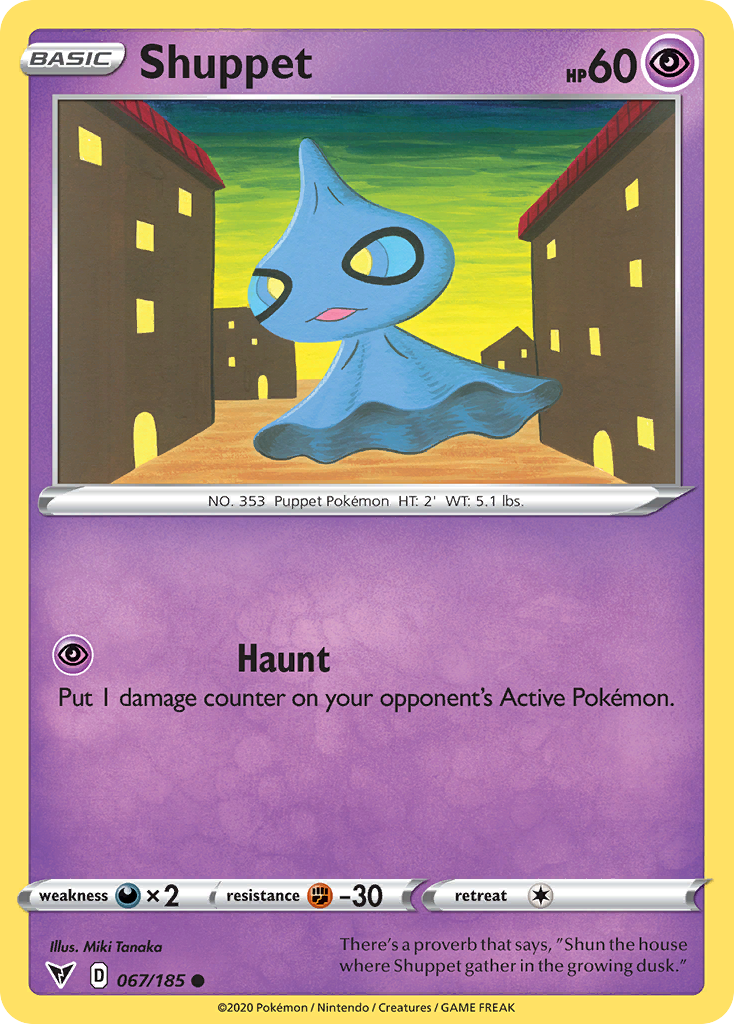

Put 1 damage counter on your opponent’s Active Pokémon.
Shuppet
There’s a proverb that says, „Shun the house where Shuppet gather in the growing dusk.“
| Supertype | Pokémon |
|---|---|
| Subtype | Basic |
| HP | 60 |
| Types | Psychic |
| Attack | Haunt |
| Attack cost | Psychic |
| Artist | Miki Tanaka |
| Rarity | Common |
| Pokédex | 353 |
| Evolves to | Banette |
Vendor Information
- Store Name: DutchGem
- Vendor: DutchGem
-
Address:
gekkestraat
179
2345GT Utrecht
Sword & Shield
Its antennae, which evolved from a fin, have both positive and negative charges flowing through them.
Chilling Reign
Any Corvisquire that pecks at this Pokémon will be greeted with a smack from its sepals followed by a sharp kick.
Sun & Moon
This attack does 30 more damage times the amount of Energy attached to this Pokémon.
151
Nidoking prides itself on its strength. It's forceful and spirited in battle, making use of its thick tail and diamond-crushing horn.
Rebel Clash
Its ability to deflect any attack led to it being known as the Fighting Master's Shield. It was feared and respected by all.
Ähnliche Produkte
Sword & Shield
It emits psychic energy to observe and study what's around it—and what's around it can include things over six miles away.
Sword & Shield
It is said to live 1,000 years, and each of its tails is loaded with supernatural powers.
Sword & Shield
Only female Salazzle exist. They emit a gas laden with pheromones to captivate male Salandit.
Sword & Shield
Attach up to 3 Fire Energy cards from your discard pile to your Pokémon in any way you like.
Sword & Shield
When it uses its special stick to strike up a beat, the sound waves produced carry revitalizing energy to the plants and flowers in the area.
Sword & Shield
Often found in gardens, this Pokémon has hairs on its body that it uses to assess its surroundings.
Sword & Shield
The faster a Thwackey can beat out a rhythm with its two sticks, the more respect it wins from its peers.
Sword & Shield
Its venom sacs produce a fluid that this Pokémon then heats up with the flame in its tail. This process creates Salandit's poisonous gas.