
| Supertype | Pokémon |
|---|---|
| Subtype | Basic |
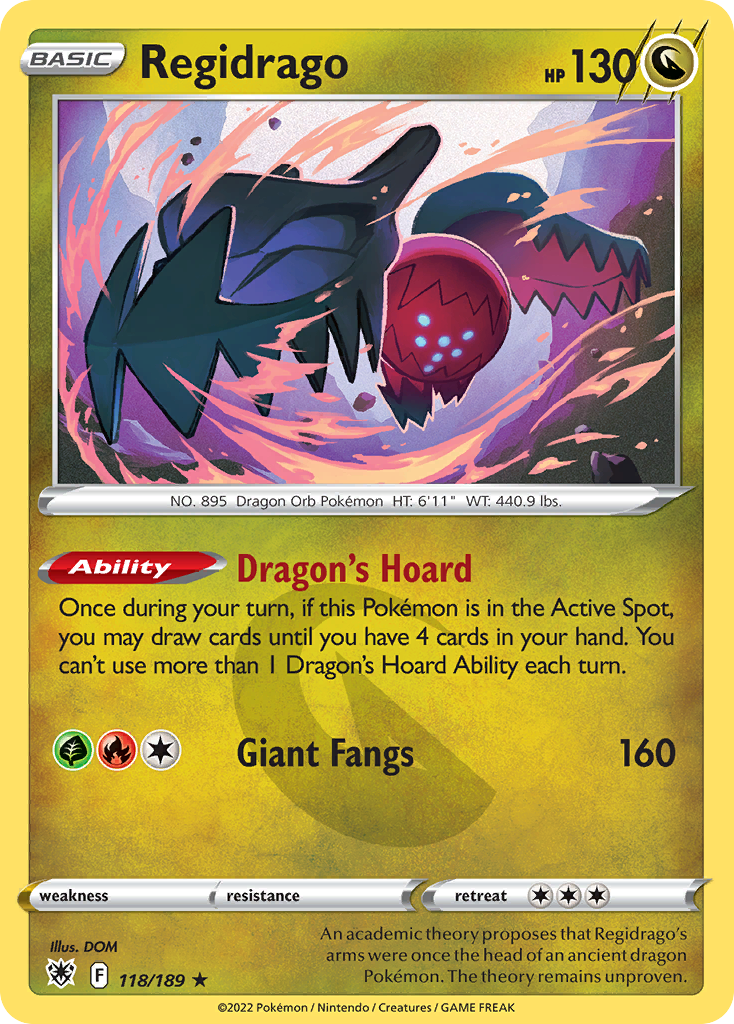
| HP | 130 |
| Types | Dragon |
| Attack | Giant Fangs |
| Attack cost | Grass |
| Artist | DOM |
| Rarity | Rare |
| Pokédex | 895 |
Regidrago
An academic theory proposes that Regidrago’s arms were once the head of an ancient dragon Pokémon. The theory remains unproven.
Vendor Information
- Store Name: DutchGem
- Vendor: DutchGem
-
Address:
gekkestraat
179
2345GT Utrecht
Sun & Moon
It reacts to anything that moves—flies right at it and bites it. Sometimes it injures itself, but it doesn't care too much.
151
It rolls to move. If the ground is uneven, a sudden jolt from hitting a bump can cause it to explode.
Sun & Moon
An ancient tradition of Alolan festivals, still carried on to this day, is a competition to slide Sandshrew across ice as far as one can.
Base
The female's horn develops slowly. Prefers physical attacks such as clawing and biting.
Lost Thunder
It stores hundreds of liters of poisonous liquid inside its body. It is one of the organisms known as UBs.
Ähnliche Produkte
Sword & Shield
It scatters cotton all over the place as a prank. If it gets wet, it'll become too heavy to move and have no choice but to answer for its mischief.
Sword & Shield
Its flowers give off a relaxing fragrance. The stronger its aroma, the healthier the Roselia is.
Sword & Shield
There's a hole in its tail that allows it to draw in the air it needs to keep its fire burning. If the hole gets blocked, this Pokémon will fall ill.
Sword & Shield
Often found in gardens, this Pokémon has hairs on its body that it uses to assess its surroundings.
Sword & Shield
Discard the top card of your deck. If that card is a Fire Energy card, this attack does 90 more damage.
Sword & Shield
After captivating opponents with its sweet scent, it lashes them with its thorny whips.
Sword & Shield
When it uses its special stick to strike up a beat, the sound waves produced carry revitalizing energy to the plants and flowers in the area.
Sword & Shield
Its venom sacs produce a fluid that this Pokémon then heats up with the flame in its tail. This process creates Salandit's poisonous gas.