
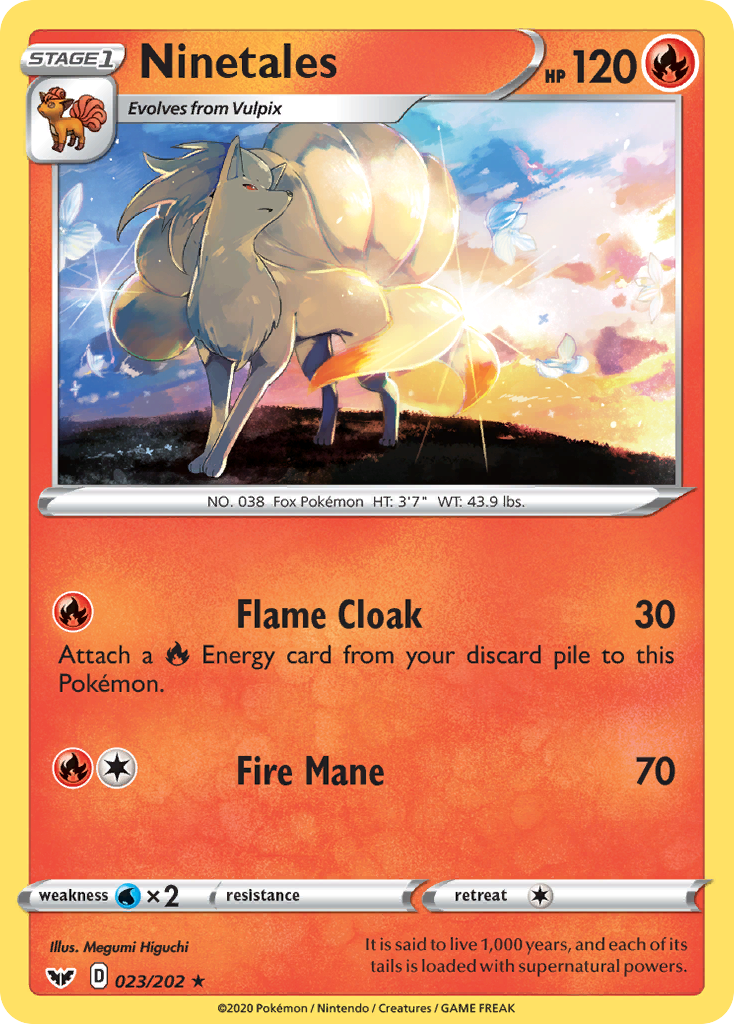
Attach a Fire Energy card from your discard pile to this Pokémon.
Ninetales
It is said to live 1,000 years, and each of its tails is loaded with supernatural powers.
| Supertype | Pokémon |
|---|---|
| Subtype | Stage 1 |
| HP | 120 |
| Types | Fire |
| Attack | Flame Cloak |
| Attack cost | Fire |
| Artist | Megumi Higuchi |
| Rarity | Rare |
| Pokédex | 38 |
| Evolves from | Vulpix |
Vendor Information
- Store Name: DutchGem
- Vendor: DutchGem
-
Address:
gekkestraat
179
2345GT Utrecht
Forbidden Light
It sends out electromagnetic waves, which let it float through the air. Touching it while it's eating electricity will give you a full-body shock.
Paldea Evolved
If your opponent’s Active Pokémon already has any damage counters on it, this attack does 120 more damage.
Phantom Forces
Attach 2 basic Energy cards from your discard pile to 1 of your Benched Pokémon.
Lost Origin
Able to freely control the hardness of its metallic shell. It loathes solitude and is extremely clingy—it will fume and run riot if those dearest to it ever leave its side.
Ähnliche Produkte
Sword & Shield
It shoots cotton from its body to protect itself. If it gets caught up in hurricane-strength winds, it can get sent to the other side of the Earth.
Sword & Shield
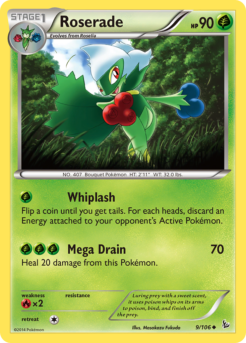
After captivating opponents with its sweet scent, it lashes them with its thorny whips.
Sword & Shield
They lay their eggs deep inside their nests. When attacked by Heatmor, they retaliate using their massive mandibles.
Sword & Shield
Its flowers give off a relaxing fragrance. The stronger its aroma, the healthier the Roselia is.
Sword & Shield
The cotton on the head of this Pokémon can be spun into a glossy, gorgeous yarn—a Galar regional specialty.
Sword & Shield
A constant collector of information, this Pokémon is very smart. Very strong is what it isn't.
Sword & Shield
It emits psychic energy to observe and study what's around it—and what's around it can include things over six miles away.
Sword & Shield
Its venom sacs produce a fluid that this Pokémon then heats up with the flame in its tail. This process creates Salandit's poisonous gas.