
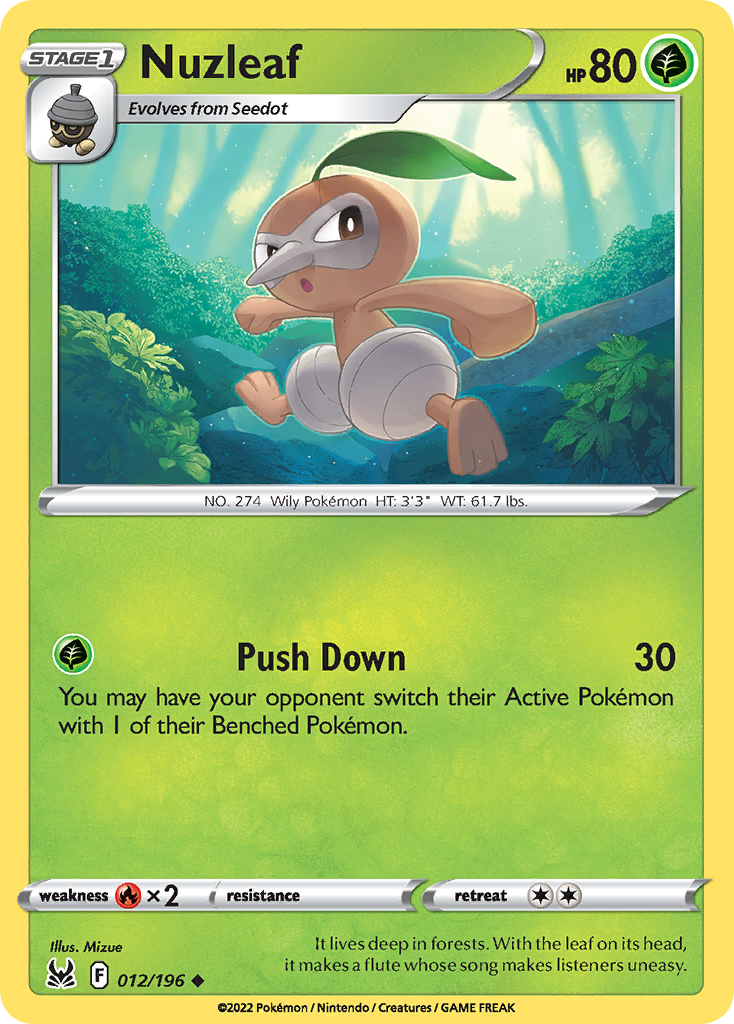
You may have your opponent switch their Active Pokémon with 1 of their Benched Pokémon.
Nuzleaf
It lives deep in forests. With the leaf on its head, it makes a flute whose song makes listeners uneasy.
| Supertype | Pokémon |
|---|---|
| Subtype | Stage 1 |
| HP | 80 |
| Types | Grass |
| Attack | Push Down |
| Attack cost | Grass |
| Artist | Mizue |
| Rarity | Uncommon |
| Pokédex | 274 |
| Evolves from | Seedot |
| Evolves to | Shiftry |
Vendor Information
- Store Name: DutchGem
- Vendor: DutchGem
-
Address:
gekkestraat
179
2345GT Utrecht
Steam Siege
One swing of the sword incorporated in its armor can fell an opponent. A simple glare from one of them quiets everybody.
Base
Thickly covered with a filthy, vile sludge. It is so toxic, even its footprints contain poison.
Fates Collide
These Pokémon prefer a tidy habitat. They are always sweeping and dusting, using their tails as brooms.
Base
Capable of living in or out of water. When out of water, it sweats to keep its body slimy.
Lost Origin
Attach up to 2 basic Energy cards from your discard pile to your Benched Pokémon in any way you like.
Ähnliche Produkte
Sword & Shield
Discard the top card of your deck. If that card is a Fire Energy card, this attack does 90 more damage.
Sword & Shield
Often found in gardens, this Pokémon has hairs on its body that it uses to assess its surroundings.
Sword & Shield
As it grows inside its shell, it uses its psychic abilities to monitor the outside world and prepare for evolution.
Sword & Shield
The faster a Thwackey can beat out a rhythm with its two sticks, the more respect it wins from its peers.
Sword & Shield
They lay their eggs deep inside their nests. When attacked by Heatmor, they retaliate using their massive mandibles.
Sword & Shield
Its flowers give off a relaxing fragrance. The stronger its aroma, the healthier the Roselia is.
Sword & Shield
Only female Salazzle exist. They emit a gas laden with pheromones to captivate male Salandit.
Sword & Shield
Its venom sacs produce a fluid that this Pokémon then heats up with the flame in its tail. This process creates Salandit's poisonous gas.