
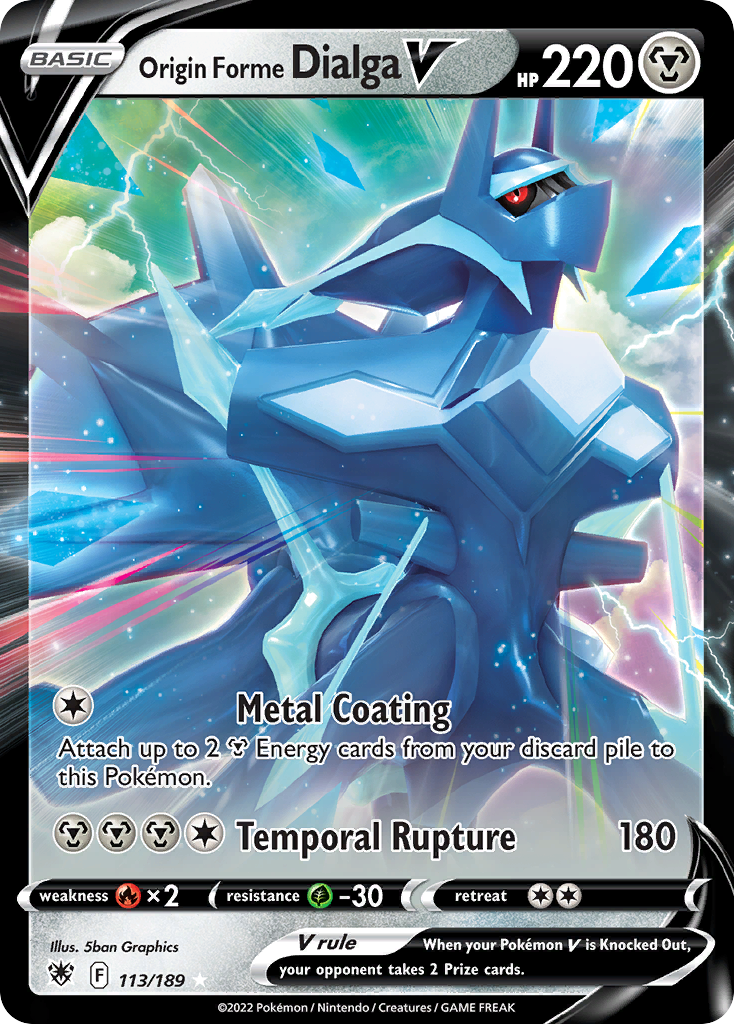
Attach up to 2 Metal Energy cards from your discard pile to this Pokémon.
Origin Forme Dialga V
| Supertype | Pokémon |
|---|---|
| Subtype | Basic |
| HP | 220 |
| Types | Metal |
| Attack | Metal Coating |
| Attack cost | Colorless |
| Artist | 5ban Graphics |
| Rarity | Rare Holo V |
| Pokédex | 483 |
Vendor Information
- Store Name: DutchGem
- Vendor: DutchGem
-
Address:
gekkestraat
179
2345GT Utrecht

Evolutions
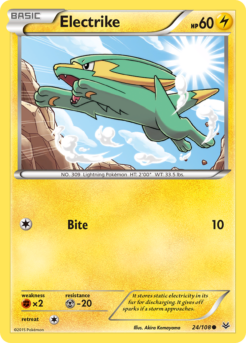
It moves while constantly hovering. It discharges Thunder Wave and so on from the units at its sides.
Rebel Clash
It emits psychic power strong enough to cause headaches as a deterrent to the approach of others.
Sword & Shield
Attach a Water Energy card from your hand to this Pokémon. If you do, switch it with 1 of your Benched Pokémon.
Roaring Skies
It discharges electricity from its mane. It creates a thundercloud overhead to drop lightning bolts.
Sun & Moon
It fights while spinning like a top. The centrifugal force boosts its destructive power by 10.
Brilliant Stars
It knows where pure water wells up. It carries fellow Pokémon there on its back.
Ähnliche Produkte
Sword & Shield
The cotton on the head of this Pokémon can be spun into a glossy, gorgeous yarn—a Galar regional specialty.
Sword & Shield
The faster a Thwackey can beat out a rhythm with its two sticks, the more respect it wins from its peers.
Sword & Shield
Its flowers give off a relaxing fragrance. The stronger its aroma, the healthier the Roselia is.
Sword & Shield
Only female Salazzle exist. They emit a gas laden with pheromones to captivate male Salandit.
Sword & Shield
While young, it has six gorgeous tails. When it grows, several new tails are sprouted.
Sword & Shield
As it grows inside its shell, it uses its psychic abilities to monitor the outside world and prepare for evolution.
Sword & Shield
It shoots cotton from its body to protect itself. If it gets caught up in hurricane-strength winds, it can get sent to the other side of the Earth.
Sword & Shield
Its venom sacs produce a fluid that this Pokémon then heats up with the flame in its tail. This process creates Salandit's poisonous gas.