
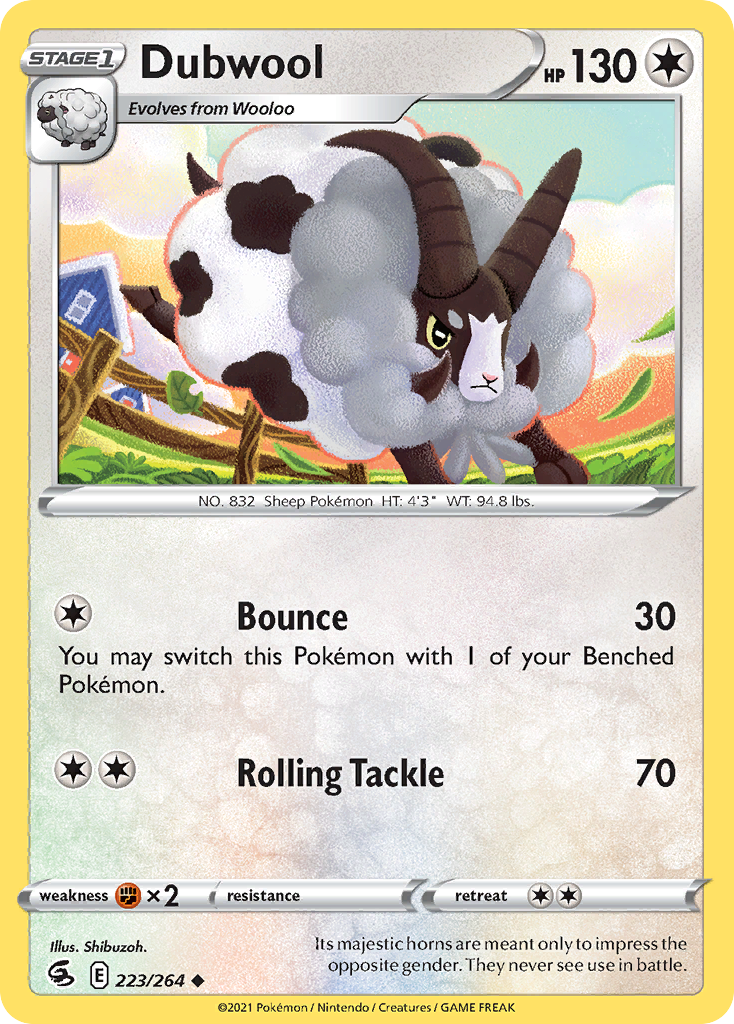
You may switch this Pokémon with 1 of your Benched Pokémon.
Dubwool
Its majestic horns are meant only to impress the opposite gender. They never see use in battle.
| Supertype | Pokémon |
|---|---|
| Subtype | Stage 1 |
| HP | 130 |
| Types | Colorless |
| Attack | Bounce |
| Attack cost | Colorless |
| Artist | Shibuzoh. |
| Rarity | Uncommon |
| Pokédex | 832 |
| Evolves from | Wooloo |
Vendor Information
- Store Name: DutchGem
- Vendor: DutchGem
-
Address:
gekkestraat
179
2345GT Utrecht
Paldean Fates
Pawmot's fluffy fur acts as a battery. It can store the same amount of electricity as an electric car.
Brilliant Stars
The ultrasonic waves it generates by rubbing its two wings together cause severe headaches.
151
The legs freely contract and stretch. The stretchy legs allow it to hit a distant foe with a rising kick.
Furious Fists
Their ribbonlike feelers increase their psychic power. They are always staring at something.
Battle Styles
Its goons take care of most of the fighting for it. The only time it dirties its own hands is in delivering a final blow to finish off an opponent.
Ähnliche Produkte
Sword & Shield
Often found in gardens, this Pokémon has hairs on its body that it uses to assess its surroundings.
Sword & Shield
Search your deck for up to 2 Pokémon, reveal them, and put them into your hand. Then, shuffle your deck.
Sword & Shield
It is said to live 1,000 years, and each of its tails is loaded with supernatural powers.
Sword & Shield
When it uses its special stick to strike up a beat, the sound waves produced carry revitalizing energy to the plants and flowers in the area.
Sword & Shield
When it uses its special stick to strike up a beat, the sound waves produced carry revitalizing energy to the plants and flowers in the area.
Sword & Shield
While young, it has six gorgeous tails. When it grows, several new tails are sprouted.
Sword & Shield
Its flowers give off a relaxing fragrance. The stronger its aroma, the healthier the Roselia is.
Sword & Shield
Its venom sacs produce a fluid that this Pokémon then heats up with the flame in its tail. This process creates Salandit's poisonous gas.